the expat guidebook

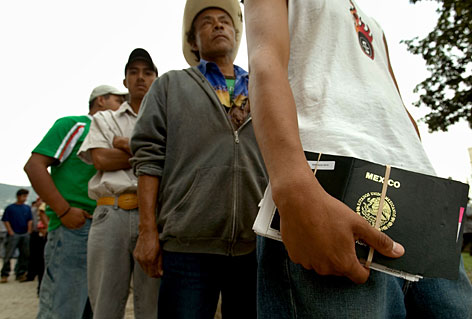
Immigration Line

Local Fixers and You – Tips for Full-Time Travel

Posted by | Live Like a Local, Mexico, Quality of Life, Traveling Tips | 2 Comments

While those of us who are traveling for a living often speak the language of the countries we are visiting, it’s not always a guarantee that where you end up will be somewhere where you can actually communicate fluently. And although you might only be on the ground a week or two, or maybe even as long as a few months on a passport stay, once you start to get into long-term immersion travel there are a variety of bureaucratic processes that can bog you down if you don’t speak the local lingo. Or, even in the case of those of us who speak the language, sometimes you just don’t want to be bothered with the hassle of doing paperwork when you can find someone else to do it for you.

Things like getting your residency paperwork filed with the local immigration office. Or getting papers notarized and translated. Or dealing with lawyers for a property purchase/sale. Every country does things differently, and as most of us have found out over the years, sometimes the only downside to living in a developing country is the bureaucracy.

Such as looking at the immigration website for your country and downloading the required papers, filling them out and then going to the local immigration office and talking to the individual at the information desk only to find out that the papers on the website aren’t up to date and you need to fill out these papers instead and supply copies of these two pages of your passport along with a translated copy of this document and copies of these bank statements.

So you take the next day to follow the instructions, come back to the office only to find another employee working…who tells you that you didn’t actually need that copy there but actually this copy here and you need two more copies of that document and this one has to be notarized but only after it has been translated and you have to be back between the hours of two and four in the afternoon only there’s a line halfway around the block to try and get it when you return so you say screw it and come back the next day and submit all your paperwork, finally, and they tell you to check the website in two weeks for an update but when you do nothing updates and you wait and you wait and five weeks later you finally decide to go to the office to find out what’s up only to find out that your paperwork has been there the entire time but no one ever entered it into the website to let you know to come pick it up, but before you can pick it up they have changed the laws and now you need these other documents filled out and notarized and…

Having done my own visa paperwork in three countries now (Bulgaria, Colombia and Mexico), I can tell you from first-hand experience that the hassle — even if it’s only once a year — can be enough to drive a person mad. In Bulgaria, for example, I went through the residency visa process three times, and every year it was completely different…and I had to spend three to five days jumping through hoops that would change on a daily basis depending on who was working. It’s literally the only thing I dislike about living in developing countries: the lack of a streamlined filing system.

Which is where local fixers come into play.

Taking One For The Team

Think of a local fixer as a temporary personal assistant. They are going to do all the little things that you don’t want to be hassled with. Like running around to the notary and the translator and the lawyer and the copy shop and the immigration office for files and copies and forms. They speak the local language and can thus communicate on a far greater level than yourself (even if you do happen to speak fluently; they are native speakers after all), but there’s something else that a local fixer has which is greater than their communication skills: Local know-how.

They know the way things work. They know who to talk to, how to grease the wheels, how to talk to the right people to get the desired result. They have built up connections with lawyers, immigration officials, bankers, notaries and beyond, which gives them a streamlined way of doing things that just isn’t available to you, even if you (like myself) happen to live in a city and speak the language reasonably well. They are often friends with the people working behind the counter at the offices and have built up a rapport with them over the years, which means your paperwork gets pushed to the front of the line rather than lingering away, lost in some bin.

But most importantly, you don’t have to waste your time doing the little things. Instead, you simply show up a couple of times, put your signature on some paperwork, pay the fixer his fee and go on about your business. Time = money, after all, and by using your time to be more productive and work on your income, you can pay a local fixer their minimal fee and let them handle the paperwork for you.

Above and Beyond

Local fixers are also often the difference between living as an expat in a specific city and being denied the right to live there and forced to leave if you have overstayed your passport stay or your visa. For the most part they are people working on the right side of the law helping to “fix” bureaucratic issues for non-native speakers of the host country language. They either work on commission, tips or referral fees (such as in the case of fixers for local immigration lawyers who get a kickback from the lawyer after they bring in a new client, who is you, the digital nomad and/or expat who needs help).

Contrary to what some people might think, fixers are not working illegally…for the most part. They do exist on both sides of the fence. However, if you do things by the book you will be working with the legal ones, the ones who are simply helping you navigate the minefield that is dealing with your visa in Japanese when you only speak English, for example.

Fixers can also take care of some shadier types of activities (disclaimer: I do not personally recommend these methods, merely mention them for your reading), such as working with a legitimate fixer to help you grease the local wheels with bribes and tips. This involves things such as paying off local officials so you don’t have to leave a country while your visa is processing or your status is changing (such as in Bulgaria). Or it could involve overstaying your visa while in a country like Russia and then having a local fixer bribe the local officials and help you navigate the loopholes to get your visa renewed and take care of your accidental hiccup.

There’s a lot of different ways fixers can help you above and beyond just visa issues. They are also extremely common in the journalism industry, as well as the travel documentary industry, helping people nail down their film and gear permits as well as access to press passes and the like. You can read more about them  and how to utilize them in your travels within The Expat Guidebook itself, but in the meantime you can watch our YouTube video on the subject as well.

This is an expanded version of a post originally written for The Expat Guidebook blog.

Don’t forget to sign up for our free newsletter for several-times-a-week, your-eyes-only travel and entrepreneur tips, plus receive a complimentary copy of our 85-page starter book on location independence and living abroad, 30 Ways in 30 Days.
With over 1,500 copies sold, our flagship 568-page eBook is what started it all. Learn how to travel the world like I do: without a budget, with no plans, funded completely by your website and online ventures.

The Expat GuidebookGet Your Copy Today!

Unplug from The System, cure yourself of The Greedy Bastard Syndrome, tap into your universal potential and create your own reality. Build a brand, travel the world and realize your cosmic consciousness.

Beyond Borders - The Social RevolutionGet Your Copy Today!

Isla Mujeres, Mexico

Living off the grid in Cancun, Mexico

Posted by | Live Like a Local, Mexico, Quality of Life, Traveling Tips | 8 Comments

One of my favorite aspects of living in Cancun, Mexico is when I have the opportunity to dispel some of the myths around the city. The first of which is that people assume all of Cancun is The Hotel Zone, the all-inclusive strip of beach-front property separated from the mainland by a lagoon and only accessible by two bridges. It’s a haven of resorts, dance clubs, bars and restaurants, all of which are over-priced and full of obese, drunk, consumption-addicted tourists from all around the world. What many people don’t realize is that there is an entire city on the mainland that is completely separate from the HZ, and it marches to the beat of a very different drum.

Cancun proper is a thriving, bustling, very Mexican hub of activity, where a smattering of the locals speak English but the vast majority are simply living life as all Mexicans live: in Spanish, simply and without the bustle and hum of the tourist section that the governments of the U.S. and Mexico both promote.

One of the primary reasons I came here was the simple fact that Cancun is smack-dab in the heart of the Riviera Maya, while at the same time boasting an international airport and a global hub of expats. The combination of easy in-and-out transportation, along with the fact this is the hub for one of the region’s busiest ADO bus terminals for routes in and around the rest of Mexico, make this the perfect hub for travelers who are here to spend time immersing themselves in the Mexican culture.

On top of that…Cancun is cheap. Or at least it’s cheap if you want to live like a local, speak Spanish and get off the beaten path. If you want to live the typical tourist lifestyle here, it’s very easy to spend 2-3k per month in living expenses, but if you are looking for middle of the road accommodations, comfortable living, cheap healthcare, high speed Internet and a modern infrastructure, you can have everything you need as a working professional for around $600 a month (individual; couples are around $800 a month; families dependent on how many).

We have two rooms available for rent in Cancun for those of you in the market for something quick and easy.

  1. View Room One Here

  2. View Room Two Here

Mirador, Cancun

I’ve covered the costs and etc. in other posts, such as Cancun – Beyond the Hotel Zone, as well as in our immersion travel guide for the city, but there’s more to it than just the cost of living. I’m a resident, here on a visa, which means I get the same bonuses as Mexicans. I have access to the universal healthcare system (costs me about $300 per year, and that gets me unlimited, free prescription medication along with free healthcare, although there are some limitations, such as no orthopedic surgeries for 2 years to make sure I’m not just going to buy in and abuse the system), and I can get into the national parks and museums for free on Sundays alongside the nationals…which means I can visit places like Chichen Itza just like the locals do.

But what if you aren’t here as a resident, but just as a temporary visitor? Even then, the costs are cheap. Especially as it relates to medical tourism. The perfect example is Dave from Nomadic Retiree. He was one of our retreat members down here for the Spring 2013 Destination Freedom brand boot camp for March, April and May. He’s getting a lot of dental work done currently. Root canal, some crowns, cavity work and beyond. We were tallying up the costs the other day and he took his quote from the United States (between $14,000 and $15,000 depending on which dentists he talked to) and compared it what he’s spending here in Mexico…basically he’s saving around $12,000 USD by the time everything is said and done…and the work he’s getting done is more professional than anything he’s ever received in the United States.

He’s going to be writing a blog series on it, so you can follow along at his website for the nitty gritty details, but the bottom line is that even if you aren’t here as a resident, things are cheap. If he was on the universal healthcare system it would be even cheaper, as some of the procedures would be covered by the healthcare, but he’s only down here as a visitor, not a resident, and you only have access to the system once you have an official visa and go pay your healthcare taxes/fees.

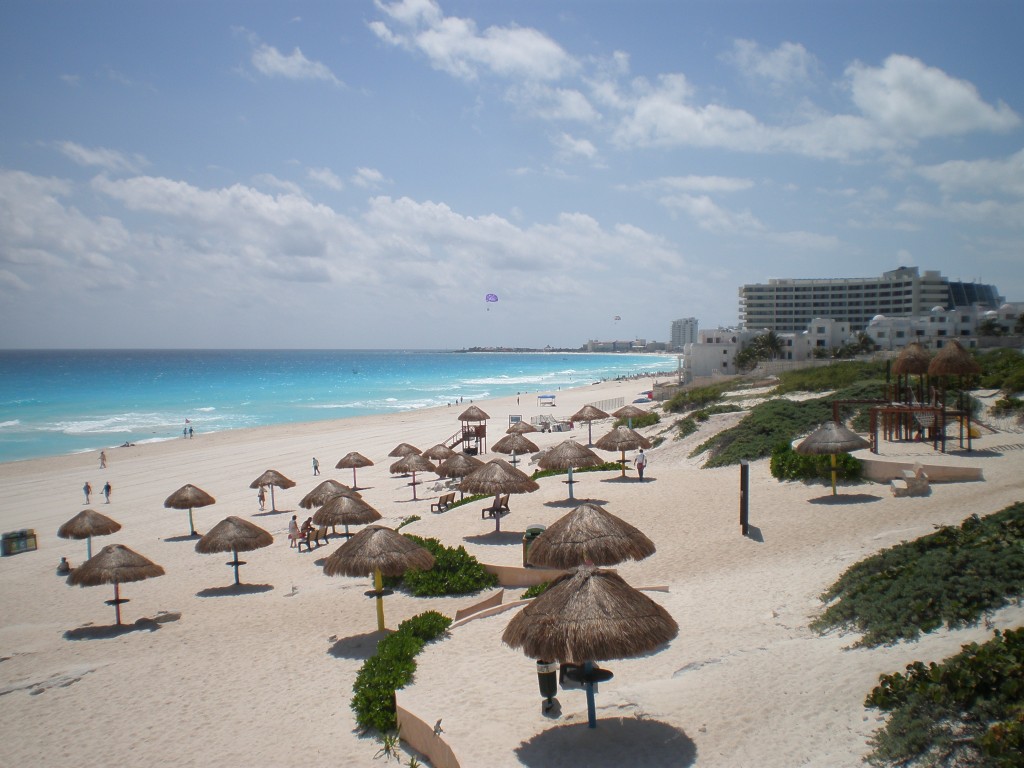
Playa Tortugas

Speaking the language also opens a lot of doors in Cancun. First of all, the taxi drivers won’t try and give you the gringo rates if you speak the lingo. Secondly, the bus drivers won’t try and short change you. Thirdly, the respect level gets cranked up to 11 when you are meeting the Mexicans on their own turf and speaking their language as opposed to being the arrogant tourist who demands their menu in English and berates the staff in the serving industry for not speaking English. I’ve already covered some of this in The Importance of Language Immersion for Expats, but the basic rule of thumb is this: when you give respect, you get respect back. It’s the age-old rule of reaping what you sow. Act like an arrogant twit, and you’ll be treated accordingly.

Knowing Spanish also gives you access to local rates on accommodations, as well as the ability to negotiate, which is one of the major bonuses of living in a Latin country: everything is negotiable. For example, my buddy DJ Vishnu negotiated a year’s worth of “free” rent at a hotel where he was staying simply by offering to manage their social media campaign for 2 hours a day and build them a new website. Which freed him up to work solely on his meditation videos and create more awesome music for his fans rather than stress about bringing in income from another source. Had he only spoken English, that door would have been completely closed to him.

There’s also an untapped market in terms of web development, social media development and beyond here on the local level, which means there are almost literally an unlimited number of job opportunities for the entrepreneurial sort who wants to come down here and put their nose to the grindstone. It’s the reason we are teaching Spanish language in our brand boot camps, so that our graduates can go on and find work not merely in English, but also in Spanish, both internationally and locally.

Destination Freedom by Marginal Boundaries

Cancun has a fairly negative reputation due to the Hotel Zone and its endless array of all-inclusive resorts and Spring Breakers, but the reality is that the city itself is completely separate. On the mainland we have quiet suburbs filled with parks and schools, Mexican barrios with 3 and 4 bedroom townhouses, a thriving middle class, the typical street food, plenty of mom-and-pop restaurants and businesses, cheap living and a completely laid-back, Bohemian way of life.

The buses run regularly, taxis are always available, there’s grocery stores every few blocks, you can find an Oxxo or Extra on every street corner, violent crimes are almost nonexistent, and it’s nothing but middle class Mexican families raising their children and living their lives no different than any other suburbia on Planet Earth. And if you get away from the Hotel Zone into the outer barrios on the mainland you’ll never see a gringo or an overweight tourist or find a strip club or hotel or any American restaurants. In fact, you’ll probably be one of the only foreigners that the locals have seen outside of when they go to the Hotel Zone or into the heart of downtown Centro.

And contrary to popular belief they don’t want to rob you, rape you, kidnap you or cut your head off. Cancun has a 2 in 100,000 murder rate compared to Washington D.C.’s 32 in 100,000 (as of 2010), so as far as safety goes, you are safer here than you are in the capitol of the U.S. Instead, the Mexican people are warm, inviting, friendly and ready to kick back a beer or smoke a joint with just about anyone. This is called the “land of tomorrow” for a reason: if you give a Mexican a reason to take a break, relax and enjoy life, they take it. End of story. And once you get a little Spanish under your belt you’ll quickly find that everyone, everywhere, is always looking to strike up a conversation and kick back a cold one, no matter the color of your skin or what country you come from.

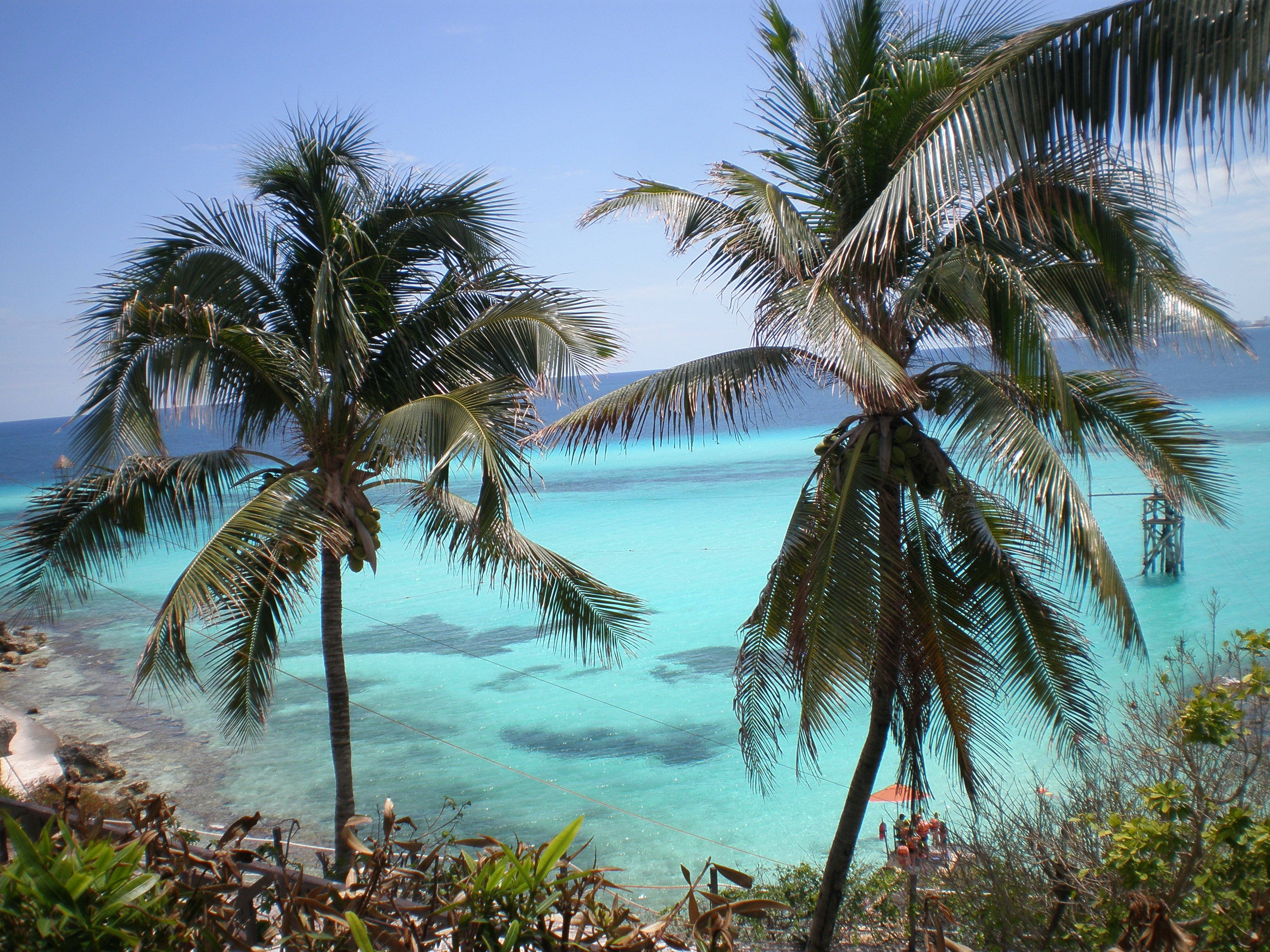
On top of all that, you have access to the entire Riviera Maya, from places such as Isla Mujeres to the secluded coves at Akumal, from Isla Blanca to Cenote Ik Kil, from Playa del Carmen to Tulum to Cozumel and beyond. This really is a magical place to be living, and I couldn’t wish for a better place to call home! Don’t forget to give us a shout if you are going to be in the area as we are always up for beers and fun, and if you have questions about anything related to long-term living in the city, whether it’s apartment rentals or beyond, let us know!

Tim and Cristina

If you want to rough it on your own, head on over to our Cancun travel page for boots-on-the-ground information, or pick up our best-selling Cancun travel guide (on sale since 2011!)

cancun travel guide

Don’t forget to check our Cancun page for dozens of videos from our time here, as well as other Cancun-specific posts below.
Cost of Living in Cancun, Mexico
Modern Mexico: The Real Story
Cancun, Mexico – Beyond The Hotel Zone
Living Off The Grid in Cancun, Mexico
Market 23 in Cancun
Market 28 in Cancun
Gourmet Italian in Cancun – Assaggiare
Tacos in Cancun – Tacos Rigo
Tacos in Cancun – Los Aguachiles
Beaches in Cancun – Playa Tortuga
Beaches in Cancun – Puerto Morelos
Social Media

Travel blogging is about more than numbers

Posted by | Live Like a Local, Passive Income, Quality of Life, Social Media, Traveling Tips | 22 Comments

The following post was written in mid-2012. It was meant to be posted around October, but I held off because I felt it would push too many buttons, offend too many of my peers…many of whose blogs I no longer follow because of the issues laid out below. I shared it with a few friends, such as Ryan from Jets Like Taxis, and I broke it down into a much longer chapter for Beyond Borders – The Social Revolution discussing the importance of “being everywhere” and how numbers don’t mean squat, but it wasn’t until I came across a recent post by Nora from The Professional Hobo discussing the evolution of travel blogging that I felt inspired to go ahead and push this live to the blog.

So. You want to be a travel blogger. You have aspirations of traveling the world, taking pictures of your travels, writing stories about them, and making money from your time invested.

In the old days, you would have had to jump through hoops and find your way past the gatekeepers of the publishing industry to make it into the print market to find readers. But in the modern era the availability of global technology, crowdfunding, social media, passive income, video chat and live streaming, the old way of doing things have thankfully gone the way of the dodo. Now, anyone with access to the Internet and a story to tell can find an audience for their adventures, without needing to prostrate themselves before someone.

That’s an important element in the evolution of the species. Equality. Sharing. Freedom of information and access to an equal level of opportunities. Working together to achieve common goals without superiority  We are moving closer and closer to a global consciousness and as technology advances we are only becoming more and more powerful at making personal connections across great distances, without the need for someone standing in the way giving us permission or denying us.

In other words, it’s incredibly easy to make a living writing about traveling. It is not a difficult job, especially if you love traveling, exploring and having adventures. I was long an Indiana Jones fan as a child, and I always wanted to be an archaeologist, and I think everyone has their own version of inspiration. Now, with the ability to travel around the world and see the sights of old and document them for others’ enjoyment…well, it’s pretty darn close to what I always wanted to do growing up.

One of the first steps to blogging for a living and using social media as a platform for passive income generation is creating an engaging environment for your blog, with depth of information that goes above and beyond and an atmosphere of equality that benefits everyone equally, as opposed to The Greedy Bastard Syndrome.The karmic principles of sharing equally with everyone builds trust, which eventually leads to profit. It’s also important, as far as travel blogging is concerned, to talk about the culture, the people and the places, and portray them from a realistic viewpoint…not merely from the consumption-based adventure travel point of view.

Unfortunately, too often in the modern era of travel blogging there is a penchant by many “travel bloggers” to pride themselves on one thing more than anything else: numbers.

The Lie of Numbers

In browsing many travel blogger websites over the past few years as I’ve developed my own brand and following of fellow expats and digital nomads, one trend has begun to emerge which in my mind completely detracts from what travel blogging is about in the first place: an obsession with Google Analytics and “top blog” contests.

While it’s certainly important from a marketing standpoint when you are looking to organize a press trip to another country while traveling on someone else’s dime to promote a hotel, airline, country, or when lining up advertising and negotiating publicity deals, do your readers really need to know how many views per month your website gets, how many followers you have, what your page rank in Google is or how many times you’ve been featured in X, Y or Z publication?

Bragging rights are all well and good, and we all want to be proud of our achievements as travelers and writers, but I sometimes feel as though there is an obsession with chest-beating that completely detracts from what travel blogs are really about: showcasing the various elements of a country, its people, the culture and the adventure of travel itself. Unfortunately, these days it seems that the majority of travel bloggers are more interested in promoting their page rank, Analytics numbers and number of followers, ranking on Klout, current press trip and how successful their Kickstarter campaign is rather than actually providing any real, valuable information to their readers. The same readers who, by the way, got them to the point where they could land press trips in the first place.

Travel blogging is about more than chest-thumping. It’s our responsibility as writers, photographers and journalists to provide an insiders’ view on what it means to travel, live and explore another country, city or culture. The primary focus of our writing should be about the stories of the people and the culture of a region and how to integrate with and experience that culture…not an advertising billboard for a hotel chain or a restaurant catering to the tourist crowd.

Often when you go to a travel blogger’s website you are spammed with a pop-up from the moment you get to the website talking about “look at how many followers I have on Facebook” or “We get 50,000 visitors per month; why aren’t you one of them?” or “Check us out, because we are a PR5 website and that means we are important!” The actual information is left by the wayside in favor of promoting the numbers as a way to achieve funding, sponsors, selling advertising space and driving sales of products related to the press trips the bloggers in question are taking.

What average readers don’t know is that these numbers don’t actually mean anything. First of all, you can buy views on places like Fiverr, which means while a person might have 20,000 followers on Facebook or Twitter…you have no idea of knowing how many of those followers are actually active, real, live people, and how many are just purchased accounts to beef up a person’s profile to make it appear as though they are actually super important. They might actually only have 500 followers who are actively engaged in their content on a regular basis while the rest are just fluff for appearance’s sake. In short, numbers are never the best nor are they the only way to judge a blog.

With that being said, a certain amount of numbers for visibility can be helpful in establishing credibility and helping to build trust. It’s the domino effect: people are more likely to read along and listen to what you have to say if they know that others are doing the same. And there’s nothing wrong with a little subtle promotion of it, such as a counter on your website or even a separate page (not a popup) or section in your About page which details your personal statistics, away from the front page and the actual content and instead in the background, where it deserves to be.

Not to mention, bloggers with smaller, more loyal audiences can trump the bigger blogs every day of the week, at least in terms of interaction. Traffic is not the only determining factor in whether or not your blog is reaching your targeted demographic; it’s also important to look at the level of interaction, sales percentages, click-throughs and beyond. A perfect example of what I’m talking about can be found at the official TBEX Blog, with a guest post written by William Bakker of Think! Social Media, talking about the 9 Criteria for Getting Invited on a Travel Blog Trip.

Specifically, there are three things in this particular article which are of vital importance to you as a blogger, even if you have nothing to do with the travel industry: your actual “reach” compared to the size of your audience, your actual authority within your niche, and your connection to other movers and shakers of your industry/niche.

While reach is an important metric, it is not as important as you might think – at least, not in terms of your power to influence readers. A blogger who has a smaller audience might very well have a higher influence than someone who has ten times the followers. For example, a blogger with only 2,000 Twitter followers may be of more value than one with 50,000 if those 2,000 people are passionate, engaged and more likely to be influenced by the person they follow.

Tools like Compete.comQuantcast and Alexa allow a far more realistic view of a blogger’s reach (as well as for analyzing your own data) than merely using Analytics alone, because remember, since people can buy Facebook likes, Twitter followers and beyond, raw numbers on a page don’t necessarily mean squat.

The other thing to think about is the fact that the blog itself is only one small aspect of your overall social media outreach. Consider this: while Marginal Boundaries the website has X views per day, I’m replicating that over numerous different places (YouTube, Facebook, Twitter, StumbleUpon, Google+, etc.), which means overall traffic is far larger than what Google Analytics alone is providing me with data on…and overall interactivity must be taken into account.

The website is only 1/6th of my overall traffic…and many of my Facebook readers don’t visit the website, or my YouTube, or the G+ page, and so forth, but only ever interact with my videos or buy products on Amazon…which means Analytics is a finite tool that only tracks a very small portion of my overall reach with the brand. I have users on social media outlets who only ever interact with me there and only ever buy products through the social media platforms…they never reach the actual website itself.

The Bottom Line

I personally feel that as a writer and travel blogger I have a responsibility to provide information about culture and travel, not a life of consumption and certainly not about how many hits per month my website gets or how many followers I have or the breakfast I’m eating from the balcony of X hotel or the bedroom with the Egyptian cotton sheets and the Jacuzzi in the bathroom. It almost seems to me that the generation of income bloggers are more interested in getting the next free press trip to X destination rather than providing actual, useful and pertinent information regarding a culture.

Instead of seeing stories about the people or the regions of a place, many travel blogs are full of sponsored blog posts on restaurants and hotels. Instead of learning about a culture or its people or the destination itself, we are forced to read yet another review of a hotel balcony view, the poolside bar, the restaurant, or one of the tourist hotspots promoted by the government/agency who paid for the trip.

Or worst…a blog post that is nothing more than an Instagram collage of food pictures or shots of adventure activities, such as zip-lining, cave tours, snorkeling, scuba diving, skiing, kayaking and beyond. There’s nothing of actual value to the article/post other than visual appeal. Sure, it’s fun to look at, and the photos certainly convey a sense of adventure and excitement, but where is the cultural appreciation? Where is the actual story about the people, the culture, the country and its ins and outs? 

Maybe it’s just me, but I’m finding myself reading fewer and fewer blogs these days because it seems that as the industry of travel blogging matures the real stories of travel are being left behind in favor of “whatever someone is paying me to write about”. And while it’s true that we all need to earn a nut to keep food on our table and fund our travels, it seems to me that some bloggers are less about actually exploring, writing about and sharing a destination or helping others with actionable advise on how to travel full time, and more about simply scoring a free trip. And as a result the real stories of culture and people and adventure and excitement are left behind in favor of virtual bragging and leveraging big-name brands who are cutting bloggers a paycheck.

I don’t want to read about your page rank. I don’t care if you have 50 followers or 50,000 followers. I could give two shits about the view from your balcony or the pool or the free mojitos or the suite with its king-sized bed. What matters to me is if you are providing me with valuable, usable content.

I want to know about traveling, not about your press kits and your Analytics numbers. I want to hear your stories about what it’s like to eat fried caterpillars in some African backwater, I want to know about the kid from Indonesia who went from being a gutter rat to a full-time traveler by learning how to design websites and make a living online. I want to read about adventures in the hidden caverns and canyons and cities and villages of a country, not about a sponsored trip to Stonehenge or the pyramids in Egypt where all you talk about is how X company or government flew you in while you promote the hotels and restaurants where you’ve racked up free meals as a result of your trip.

Tell me a story about culture. Show me the living conditions of the local people. I want to learn about the off-the-beaten path places. I want to know what it means to go to a country and live there. I want to read about immersion in a culture, how to live there and be part of the people, make local connections and do more than simply talk about numbers.

While I understand that for some travel bloggers their gig is scoring as much free stuff as possible, it has soured my view of the travel blogging industry as a whole. Perhaps it’s a personal thing, but I am much more interested in people who are actually exploring cultures and people and helping make the world a better place through exploration and sharing the Human Experience rather than read about yet another travel blogger beating their chest regarding how many free trips they took this year or who is sponsoring their next hotel stay.

When advertising trumps your content, you are no longer a travel writer; you are a puppet on a string. 

Don’t forget to sign up for our free newsletter for several-times-a-week, your-eyes-only travel and entrepreneur tips, plus receive a complimentary copy of our 85-page starter book on location independence and living abroad, 30 Ways in 30 Days.

With over 1,500 copies sold, our flagship 568-page eBook is what started it all. Learn how to travel the world like I do: without a budget, with no plans, funded completely by your website and online ventures.

The Expat GuidebookGet Your Copy Today!

Unplug from The System, cure yourself of The Greedy Bastard Syndrome, tap into your universal potential and create your own reality. Build a brand, travel the world and realize your cosmic consciousness.

Beyond Borders - The Social RevolutionGet Your Copy Today!

Human Potential

When Economic Crises Hit, Expats and Entrepreneurs Thrive

Posted by | Live Like a Local, Passive Income, Quality of Life, Social Media, Traveling Tips | 2 Comments

When Tony Wagner, the Harvard education specialist, describes his job today, he says he’s “a translator between two hostile tribes” — the education world and the business world, the people who teach our kids and the people who give them jobs. Wagner’s argument in his book “Creating Innovators: The Making of Young People Who Will Change the World” is that our K-12 and college tracks are not consistently “adding the value and teaching the skills that matter most in the marketplace.

This is dangerous at a time when there is increasingly no such thing as a high-wage, middle-skilled job — the thing that sustained the middle class in the last generation. Now there is only a high-wage, high-skilled job. Every middle-class job today is being pulled up, out or down faster than ever. That is, it either requires more skill or can be done by more people around the world or is being buried — made obsolete — faster than ever. Which is why the goal of education today, argues Wagner, should not be to make every child “college ready” but “innovation ready” — ready to add value to whatever they do.

EducationToday,” Wagner said via e-mail, “because knowledge is available on every Internet-connected device, what you know matters far less than what you can do with what you know. The capacity to innovate — the ability to solve problems creatively or bring new possibilities to life — and skills like critical thinking, communication and collaboration are far more important than academic knowledge.”

Read the full article over at The New York Times, courtesy of Thomas L. Friedman. 

One of my personal favorite moments from the article was when the author, Friedman, discussed the current state of affairs. “My generation had it easy. We got to “find” a job. But, more than ever, our kids will have to ‘invent’ a job. (Fortunately, in today’s world, that’s easier and cheaper than ever before.) Sure, the lucky ones will find their first job, but, given the pace of change today, they will have to reinvent, re-engineer and reimagine that job much more often than their parents if they want to advance in it.”

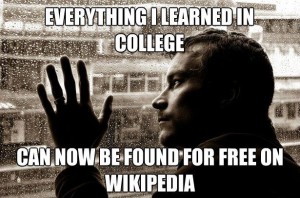
In the age of free information, ignorance is a choice. The ability to innovate, to adapt, to evolve with the times, is crucial to your continued success on a global scale. While there are still a handful of brick-and-mortar examples that continue to hold steady (albeit in very specific, tight niches), the vast majority of jobs have moved into the digital era, which means they are available to anyone on a global basis. The above photo is accurate beyond a shadow of a doubt: information that you previously had to pay hundreds of thousands of dollars to have access to is now available freely on the Internet, which means higher education is largely irrelevant in the modern era.

That’s not to say that there aren’t jobs which still require specialized knowledge. Dentistry, for example. Quantum physics. Neuroscience. But these are nothing more than a handful of degrees that require the use of a dedicated education system. The vast majority of other degrees (such as the world’s most over-marketed and least useful, the Masters of Business Administration) are available completely for free online.

Not only that, but there are jobs today which did not exist even as few as five years ago. Social media managers, for example. To this day, the vast majority of universities do not have a degree program for social media, nor do they have a university program for self-publishing books or blogging for a living or creating a YouTube channel and building up a brand. These are jobs which have been created out of the ether that is Virtual Reality, the digital era that we are now living in.

Automobiles. Airplanes. Telephone. Computers. Internet. WiFi. Crowd funding. Faster and faster. Onward and upward. Human ingenuity knows no bounds, for we are the children of the universe: infinite in our potential for expansion and growth.

Our understanding and growth have exponentially increased at every turn. Leaps and bounds are happening within a matter of months now, rather than decades apart. Just as the Mayans predicted with their endless cycles of compounded and sped-up cycles as things progressively begin to vibrate faster and faster and faster until we reached the end of the last era and entered into the endless possibility stage and moved into the great beyond, the infinite universe.

With the power of free information on a global scale, with global communication, comes the ability to advance the entire race forward at the same time. No more “my country versus your country”. No more nationalist beliefs holding people back from working side by side over a misguided notion that because someone was born somewhere else they are inferior. No more 99% versus 1%. No more reliance on a system of control telling you how to think, how to work, how to live. There is only the Human Experience as the entire planet works together to achieve the same goals.

We have the ability to create infinite realities merely through thought and will. To create something in a digital space and have that extend outwards into the physical realm. Blogs. Websites. YouTube videos. Digital eBooks and other products. We understand, finally, the symbiotic nature of it all, and the planet is moving away from capitalist and selfish systems of personal gratification and into a global community of sharing, networking and outward expansion and understanding.

IlliterateIn the words of Alvin Toffler, “The illiterate of the 21st century will not be those who cannot read and write, but those who cannot learn, unlearn, and relearn.”

In short, those who cannot adapt to the times, those who refuse to evolve with the digital era, those who cannot comprehend the vastness of the universe and their own infinite potential, will be left behind.

Evolution does not wait for the weak, the slow, the ignorant. It is survival of the fittest, and only those who have the desire to educate themselves, to unplug from The Matrix, who will mature into the next stage of The Human Experience.

The only people suffering from the so-called “global crisis” are those who have put their faith in credit systems, in governments, in the so-called “higher education” system and their so-called “required” degrees. The only ones currently sitting around without any work and living third-world lives, even in first-world countries, are those who choose to be ignorant, such as this poor sap who went from a $75,000 a year job as an architect to making less than poverty-level income (according to U.S. standards) with the snap of a finger.

He has submitted more than 3,000 resumes in a period of three years, which have only generated a half-dozen interviews…and a mere $10,000 per year for his efforts, and yet despite all of this, despite thousands of hours of wasted time and energy, despite three years of watching his life savings drain away, despite the the fact that the jobs he once thrived on no longer exist, he still prefers to stay plugged into The Matrix and live within the illusion.

He cannot comprehend the changes the world is going through because he refuses to unplug, to wake up, to enlighten himself. He is, as Alvin Toffler described, one of the illiterate of the 21st century. A man living in the dark, choosing to remain ignorant when there is a world of free information at his fingertips, freely available and freely accessible to anyone, anywhere, regardless of language, birthplace, religion or color of skin.

We are living in a time of infinite possibilities. That is what the new era represents. A time of change. A time of growth. With our understanding of the universal truths, we realize that we don’t have to do things the way they have been done before. The credit system or the banking system or the so-called global crisis are nothing more than peripheral. Our focus is on the future, on the new way of doing things, on the global consciousness of the entire planet working towards common goals and expanding our knowledge of science and technology to unlock the rest of the mysteries of the universe.

The journey is far from over, my friends. The best is certainly yet to come.

Don’t forget to sign up for our free newsletter for several-times-a-week, your-eyes-only travel and entrepreneur tips, plus receive a complimentary copy of our 85-page starter book on location independence and living abroad, 30 Ways in 30 Days.
With over 1,500 copies sold, our flagship 568-page eBook is what started it all. Learn how to travel the world like I do: without a budget, with no plans, funded completely by your website and online ventures.

The Expat GuidebookGet Your Copy Today!

Unplug from The System, cure yourself of The Greedy Bastard Syndrome, tap into your universal potential and create your own reality. Build a brand, travel the world and realize your cosmic consciousness.

Beyond Borders - The Social RevolutionGet Your Copy Today!

Marginal Boundaries Destination Freedom

A Riviera Maya Adventure

Posted by | 30 Ways in 30 Days, Live Like a Local, Mexico, Passive Income, Quality of Life, Social Media, Traveling Tips | No Comments

We are hip-deep in the Spring Destination Freedom retreat. If you haven’t been paying attention to the Facebook and Google+ pages or the YouTube channel, there have been plenty of photos + videos going up of the classes.  And things aren’t slowing down here!

Not only have we been busy getting everyone’s brands built up (the next two weeks are specifically dedicated to content creation at their websites + interviews coming to the YouTube channel), but Wandering Earl guest-spoke for a couple of nights, and we have a group dinner out with him and his tour in Playa del Carmen this evening, along with foXnoMad, since he’s helping Earl with his Mexico tour.

While the presentation for the Summer Destination Freedom event is coming down the pipeline later this week (early access for our loyal newsletter subscribers before we go public at the end of March), we also have a special tour I’d like to announce to the Marginal Boundaries community.

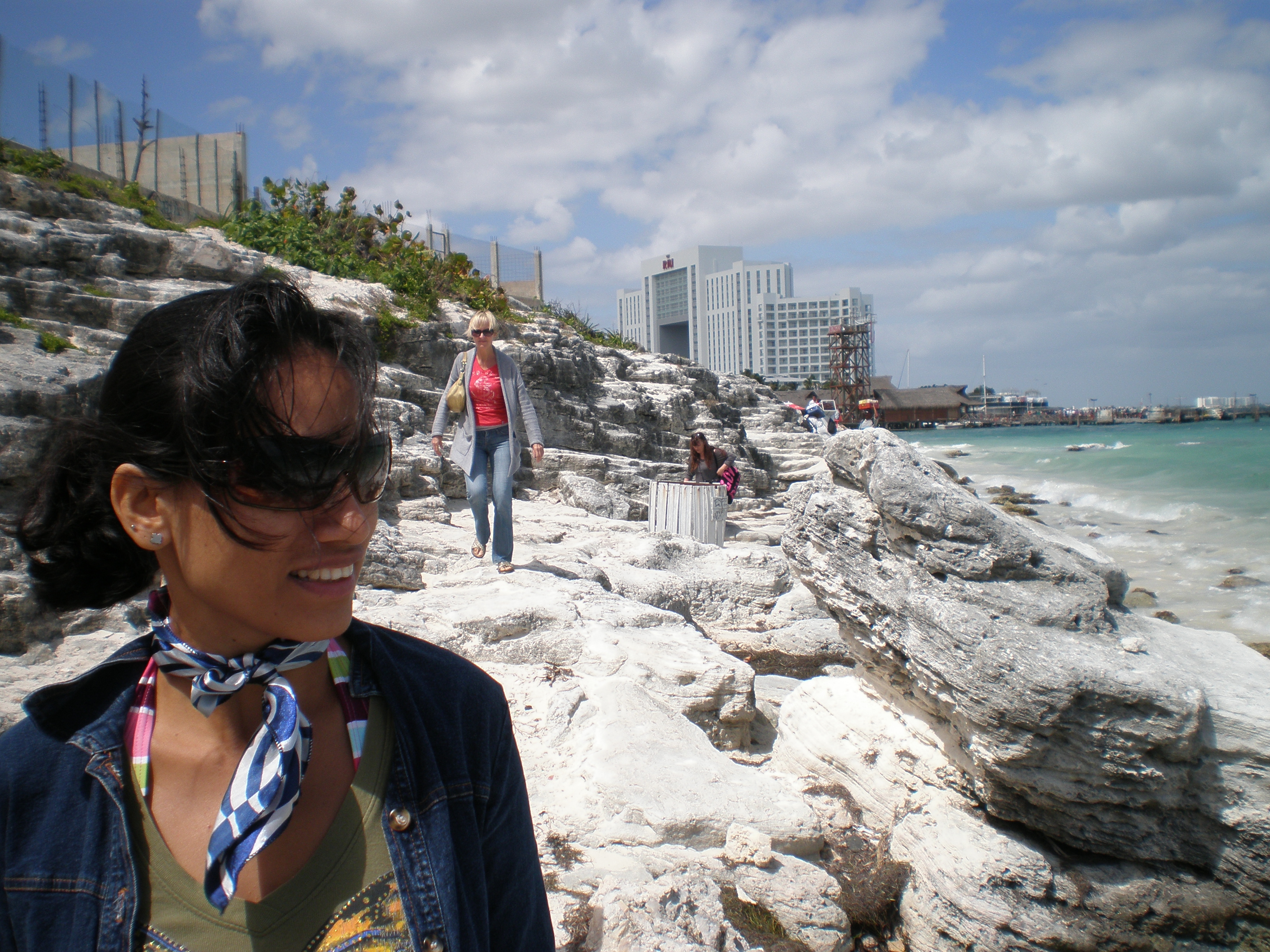
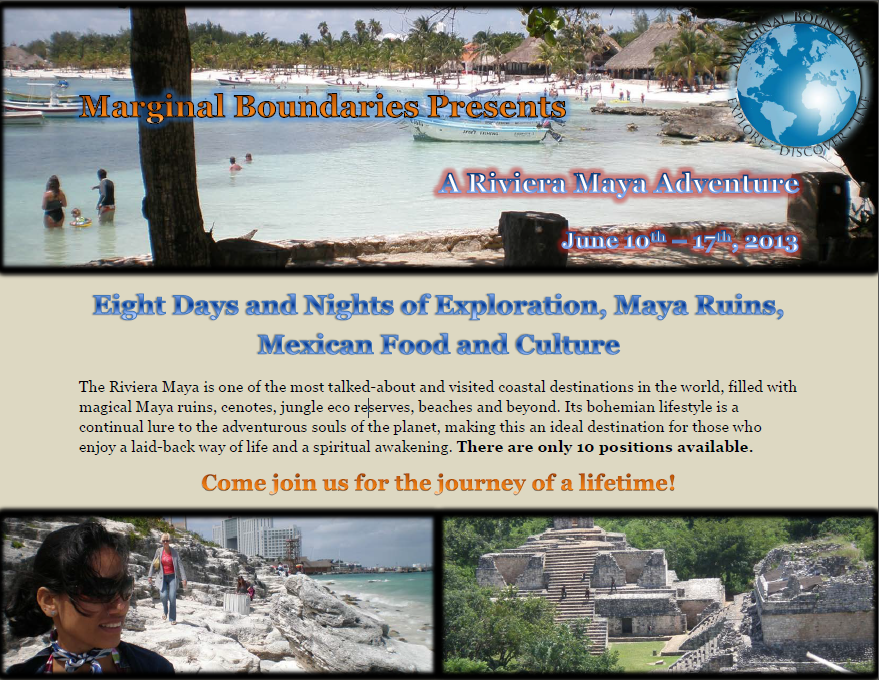
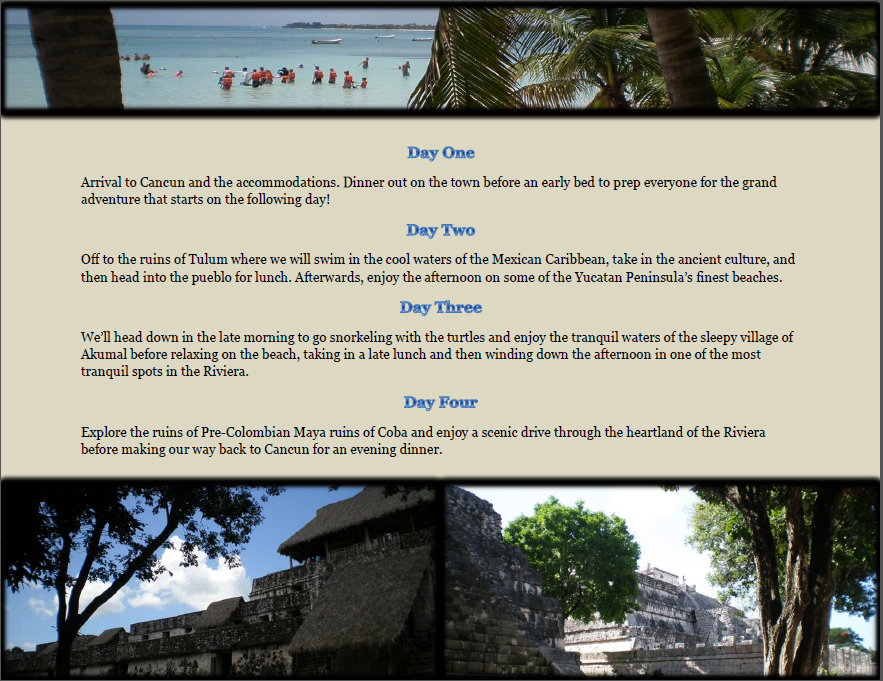
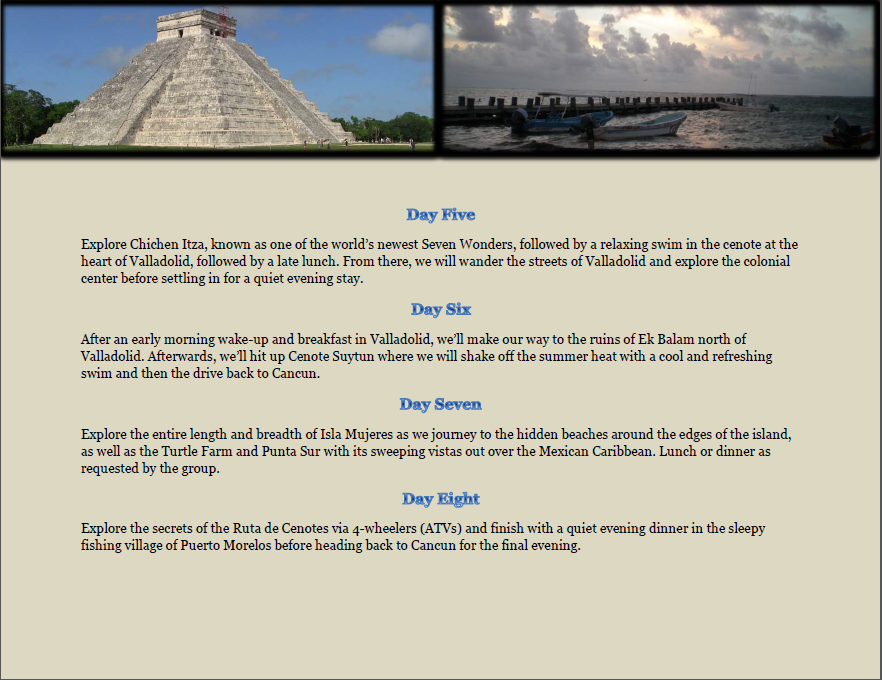
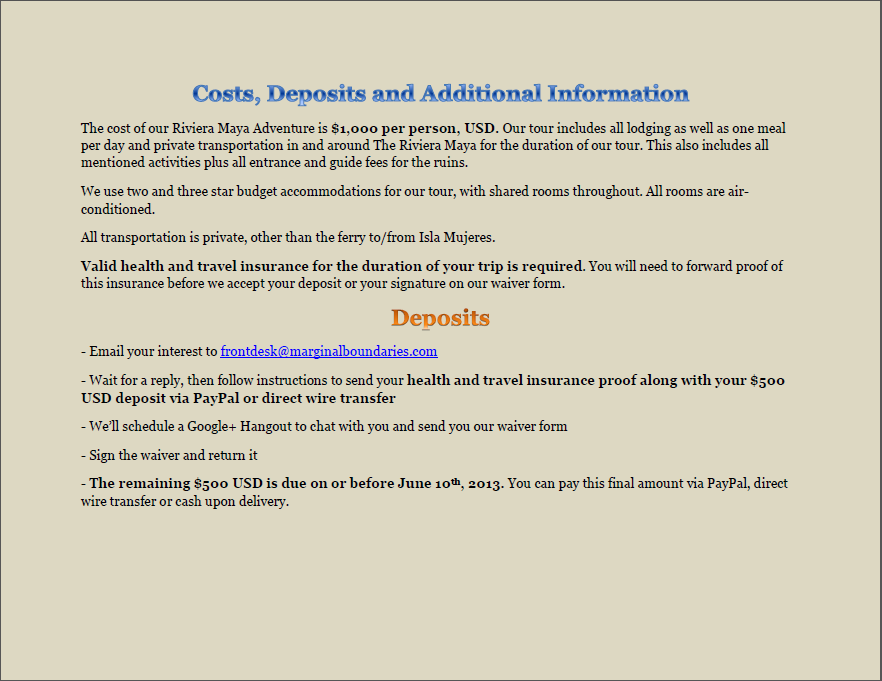
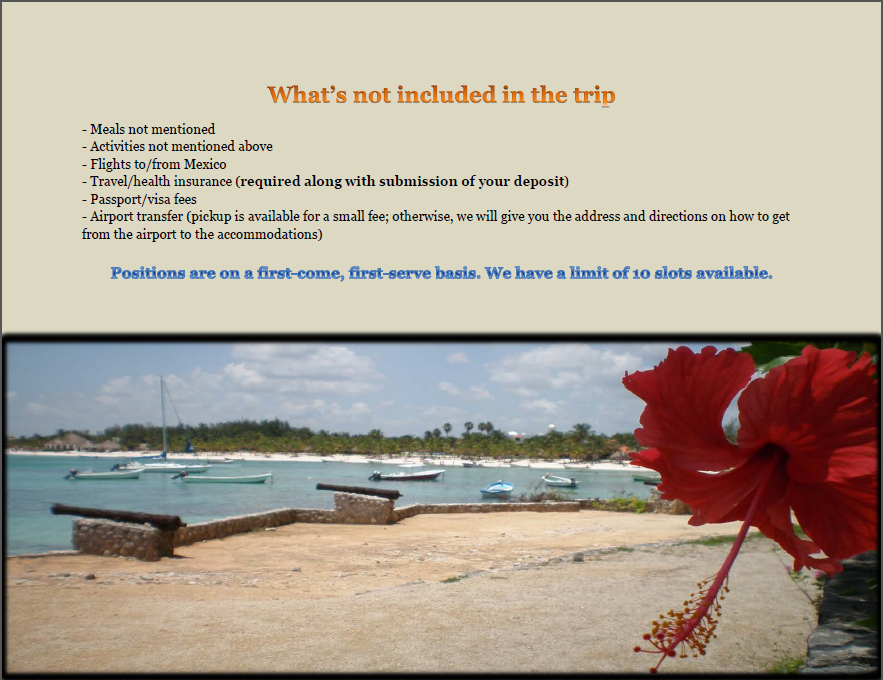
In June, in between the Spring and Summer Destination Freedom retreats, we are putting together an 8 day/8 night Riviera Maya adventure tour for those of you who want to come down to Mexico and hang out with Cris and myself while we take people around some of the local hangouts where we live.

For more information, check out the photos below, and if you think you might be interested in coming, send us an email at frontdesk@marginalboundaries.com.


Riviera Maya Adventure One

Riviera Maya Adventure Two

Riviera Maya Adventure Three

Riviera Maya Adventure Four

Riviera Maya Adventure Five

Don’t forget to sign up for our free newsletter for several-times-a-week, your-eyes-only travel and entrepreneur tips, plus receive a complimentary copy of our 85-page starter book on location independence and living abroad, 30 Ways in 30 Days.
With over 1,500 copies sold, our flagship 568-page eBook is what started it all. Learn how to travel the world like I do: without a budget, with no plans, funded completely by your website and online ventures.

The Expat GuidebookGet Your Copy Today!

Unplug from The System, cure yourself of The Greedy Bastard Syndrome, tap into your universal potential and create your own reality. Build a brand, travel the world and realize your cosmic consciousness.

Beyond Borders - The Social RevolutionGet Your Copy Today!