
expat living

Time

Throw Away Your Watch

Posted by | Uncategorized | 2 Comments

We are, as a species, nothing more than physical manifestations of The Universe. We are the exact same as the ants of the Earth, the birds of the air, the fish of the sea, the plants that sink their roots down into the rich soil. A bird does not need a manager or a schedule or a spreadsheet to tell them when to lay eggs, when to fly, when to eat, when to hunt for food, when to mate. A bird does not need a schedule to order its life; it simply lives.

You and I are no different than the animals and the plants of our Home, Planet Earth. We do not need banks and credit and 40 hour work weeks and 15 minute breaks and 30 minute lunches and 2 weeks of paid vacation and four sick days and two personal days and a boss and a manager and a house payment and a car payment and beyond. We simply need communication and freedom of information to allow us to flourish in all the ways that The Universe has made available in its infinite possibilities. 

The Research

Psychological Review published a study based upon research performed in 1993 which showed that individuals who only work four-hour shifts are far more productive in comparison to those who work eight hours a day. People’s minds function better when they have a specific task at hand that they can focus on over short periods of time, rather than being required to multitask and spread their energy out over multiple hours and multiple job requirements.

There have been a variety of professionals who back up this claim, including best-selling authors such as Stephen King or Tim Ferris, the guy behind the Four-Hour Work Week book. According to Business Weekly“While completing a novel, famous authors tend to write only for 4 hours during the morning, leaving the rest of the day for rest and recuperation. Hence successful authors, who can control their work habits and are motivated to optimize their productivity, limit their most important intellectual activity to a fixed daily amount when working on projects requiring long periods of time to complete.”

Timekeeping

The basic concept is simple: the brain is most focused during short bursts of energy. And yet despite the research, and despite the fact that multiple cultures around the world have been employing this principle (albeit on a more physical, heat-and-bodily-safety level) for millennia, we continue to see countries such as the United States pressuring people into believing that eight hour work shifts are more productive, and that anyone who doesn’t work eight hours a day is somehow inherently lazy or unproductive. “Take a nap?” your boss asks with incredulity in their voice. “Out of the question. We have a schedule to maintain here, and a bottom line to push. You’re burning daylight, so get back to work!”

I did some initial research on this topic back in February of 2010 for one of my clients, where I took a look at the raw numbers and compared the United States to Italy in terms of productivity. You can read the whole post here, but the gist of the study (another person’s numbers, not my own) was that when you compare the average U.S. citizen compared to the average Italian citizen, the Italians are 76 percent more productive on a hours-worked-per-year basis…yet they are only working half the hours that regular U.S. citizens work! That’s right…half the hours. 20-25 hours per working week, and they are one of the cultures that employs the siesta as part of the regular routine…at least in the Mediterranean regions of Italy.

People who work fewer hours per day, on their own schedule from a position of well-rested happiness and enjoyment of their work, outperform 40 hour wage slaves every day of the week, in every way. 

The Cultural Point of View

The first thing I tell people when they arrive in Mexico to take part in one of our retreats (and it’s mentioned in both The Expat Guidebook as well as Beyond Borders) is “throw away your watch”, just as the title of this posts suggests. But it’s not just because they need to adopt a new point of view for the classes and the schedule we work on while living here in Mexico. It’s also part of the culture down here: people just simply don’t pay attention to time in the way that Westerners do.

When a dinner party is set to start at 9 p.m., the vast majority of the guests don’t start arriving until 10 or 10:30. If a person says they will be there in an hour, it could be two or three hours before they actually arrive. The same goes for Colombia, Bulgaria, Serbia, Macedonia and dozens of other countries I’ve traveled to and lived in since I started traveling in 1999. Only in The West is there an addiction to time, an addiction to schedules and routine and structure and rules, rules, rules, rules.

A watch will only cause you frustration in Mexico and other countries that operate on a take-life-as-it-comes pacing. You will constantly be glancing at it and cursing the fact that everyone around you is “late”. But late according to whom? You, the “Master of The Universe”, the “frantic Westerner”? Or late according to your watch, which is a simple device that shows you a set of arbitrary numbers that have nothing to do with life or love or passion and evolution and universal understanding.

Cast Off Your Chains

Because you aren’t going to need them where you’re going. The land of never-ending sunsets, endless sunrises, countless days spent wandering the lost paths of adventure in your host country…time simply fades away once you leave the rat race of the Western world and corporate greed behind. When you start traveling the world and exploring other countries you find a truth buried behind the propaganda the Western world tries to spread about them. These are simple human beings doing the same things that human beings all over the planet do: live life. They just do it at a different pace.

One of my favorites is when Westerners try to look at countries where the siesta still functions and term those people unproductive or lazy. In whose eyes? For those of you who have read any of my previous materials you know that I actively preach the siesta concept, or only working a few hours per day and making sure to have plenty of rest including a nap in the afternoon.

The reasons for this are numerous, but the point is that just because people around the world enjoy a relaxed pace and naps in the afternoon doesn’t mean they are lazy. They just don’t rely on Americanized time where everything is broken down into 8 hour work shifts with 30 minute lunch breaks and a 15 minute break in the morning and another one in the afternoon and overtime and double pay and holiday pay and structure, structure, rules, rules.

Take Colombia, for example. Most people in the business world work 8 to 12, break until 2, then work 2 until 6. And there, just like in Bulgaria or Mexico or Uruguay or Italy or Turkey or numerous other countries, if someone says they are going to be there in 30 minutes it might actually be more like an hour and a half. Punctuality is not a concern in most countries outside of the U.S. and the U.K., and that’s something which is very difficult for some people to break away from. It’s one of the leading concerns for first-time expats and digital nomads haven’t yet learned to disconnect.

The Disconnect

If you’ve been on the road for any length of time this probably doesn’t affect you anymore. One of the nice things about getting out of the “system” or unplugging from the Matrix is that you don’t need to adhere to the breakneck pace of life anymore. You can take things slowly, one day at a time, and you don’t have to worry about a never-ending tide of stress-inducing factors.

It’s just a shrug-your-shoulders, let-the-day-pass-as-it-will attitude that could be best described as Bohemian if you had to put a term to it. It’s the kind of mentality that says it doesn’t really matter if it’s nine in the morning….I wouldn’t mind a couple of mojitos and a joint while lying on the beach or going surfing or cenote diving. Or at two in the afternoon. Or whenever.

If you haven’t experienced this yet, let me tell you from personal experience: absolute creative and financial freedom is the ultimate experience. No screeching alarm clock telling you when to wake up, no boss leaning over your shoulder demanding productivity from you…there’s simply your own desires to create what you want, when you want, and then using those creations to fund your lifestyle. 

That’s not to say it doesn’t take hard work. If you want to get into movie-star shape you have to spend 3-4 hours a day, every day of the week, in the gym pushing your body to its absolute limits. The first few months are incredibly hard. Being your own boss has its own levels of difficulty attached. But once the routine is establish and you are living life on your own terms….

I put more money in the savings in my first three years of being a digital nomad than I did in the ten previous years when I was working in a trade that I grew up in and was earning $75+ an hour. And I did it all by working at my own pace. Drinking beer/wine/whiskey on the clock. Working out of Internet cafes. Without shaving. In the same clothing for two or three days at a time (yeah ok that’s probably not such a great thought, but hey, it’s the freedom to slack off while working that counts!). Having the ability to work on my projects when I wanted, not when someone was telling me to…no matter if it was in the middle of the night, the middle of the afternoon, on a beach, in my bed, on a plane, bus or just out at a restaurant.

So relax. Cast off those shackles. Shred that time-card in half and start living life the way you want and you’ll find yourself with all sorts of free time to just explore your creativity and true human potential…once you throw away your watch and learn to stop worrying about some silly little numbers.

The above excerpts were pulled from the pages of The Expat Guidebook, the associated blog, and Beyond Borders – The Social Revolution

Don’t forget to sign up for our free newsletter for several-times-a-week, your-eyes-only travel and entrepreneur tips, plus receive a complimentary copy of our 85-page starter book on location independence and living abroad, 30 Ways in 30 Days.
With over 1,500 copies sold, our flagship 568-page eBook is what started it all. Learn how to travel the world like I do: without a budget, with no plans, funded completely by your website and online ventures.

The Expat GuidebookGet Your Copy Today!

Unplug from The System, cure yourself of The Greedy Bastard Syndrome, tap into your universal potential and create your own reality. Build a brand, travel the world and realize your cosmic consciousness.

Beyond Borders - The Social RevolutionGet Your Copy Today!

Market 23, Cancun

How To Save More than $5,000 A Year On Groceries While Living Abroad

Posted by | Live Like a Local, Quality of Life, Traveling Tips | 2 Comments

For those of you who are regular readers, the lowered costs of living in another country is a familiar topic. For those of you who are new to the scene, this might be something you aren’t aware of simply because you’ve never been informed of just how much money you can save by living abroad. But when you start spending more time in developing countries, the amount of money you can put back into your pocket is staggering in its scope.

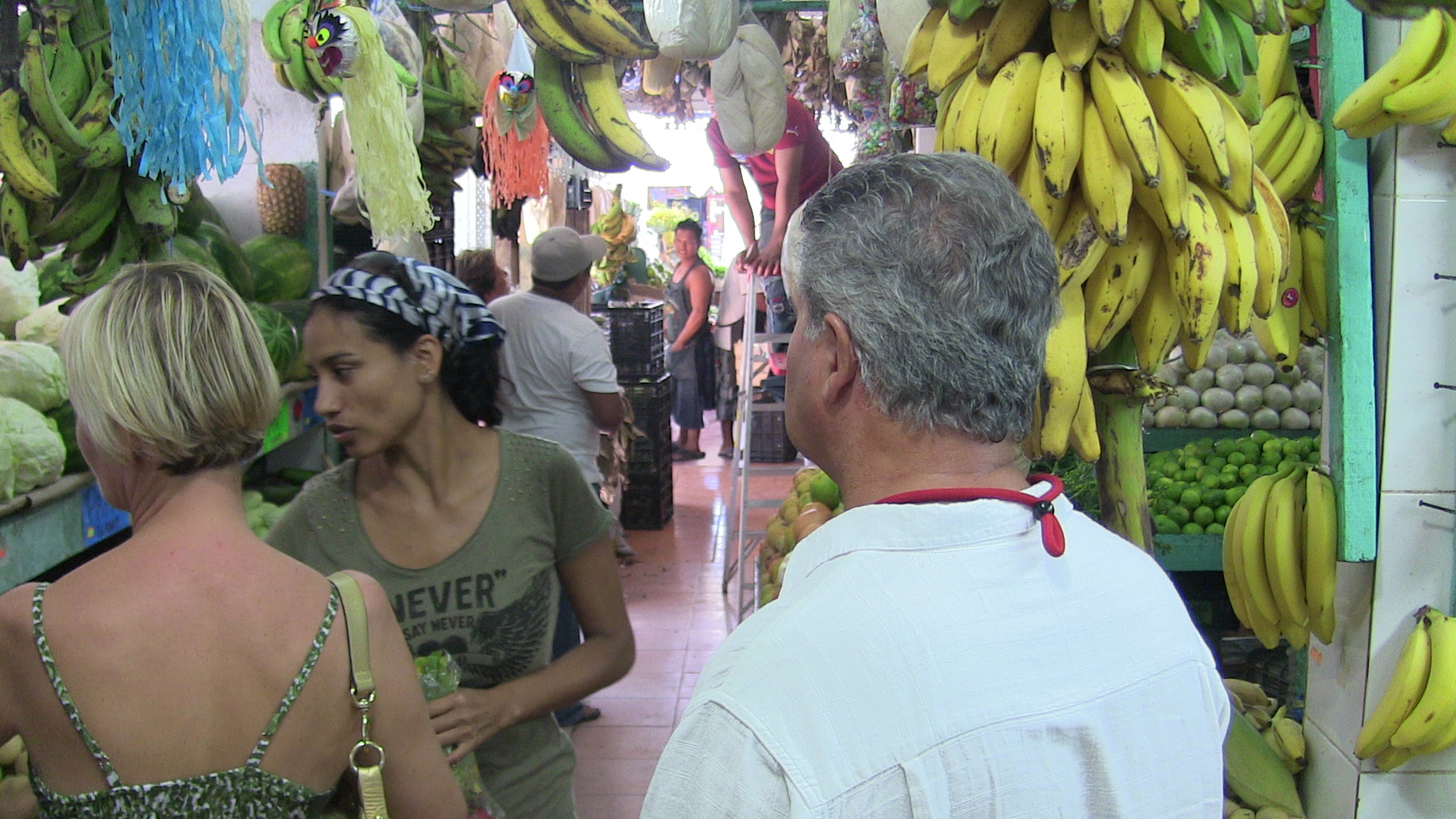
Such as picking up produce at local markets as well as saving your grocery shopping for market days when you can pick up produce and fruits for a fraction of their normal cost…which means you can walk away with savings that are worth hundreds of dollars per month and thousands of dollars per year.

In the accompanying video you’ll see me give you a basic breakdown of the type of savings I enjoy by shopping at the local level while living abroad as an expat. While the average grocery bill for an American is $6,500 per year (according to the Department of Labor as reported by TLC ), I spend a mere $1,000 per year in comparison. That’s $5,500 savings per year, and yet I’m eating the exact same foods that I was when I was living in Colorado…it’s just that I’m purchasing things in a country where I’m not charged an arm and a leg for simple groceries.

Think about that for a minute. Let it sink in. I know it’s hard to imagine, because you (readers in The West/U.S./U.K.) are so used to paying such obscenely high prices for your groceries that it must sound like an impossibility to be able to save over five thousand dollars on your annual grocery bill. And remember, these numbers are from the U.S. government itself…and they only represent the grocery bill for a single, average, median-cost-of-living American. The grocery bill for couples double…and when you add kids into the equation you can see that number quadruple or beyond. (Assuming average, middle-class Americans. Remember that these numbers are the “average”; some people spend more, some people spend less, through coupons and smart shopping).

Now think about this: if the average household (family of four) is spending $6,500 per year, per adult, that’s $13,000 per year. Throw a couple of kids into the mix and you can assume a minimum of $20,000 per year on food alone. Now, compare that to living in a place like Mexico City or Cancun, where two adults can eat like kings on a mere $2,000 a year. Add a couple of kids into the mix and you are talking about around $4,000 a year.

That’s basic, grade-school math that anyone can see. $20,000 a year versus $4,000 a year for a family of four. For two adults it’s $2,000 per year versus $13,000 per year. For a single individual, it’s $1,000 per year versus $6,500 per year. The savings by living like a local are literally thousands of dollars a year back into your pocket.

Don’t believe me? Just check out the following video for the most basic type of evidence. I’m only going into tomatoes, mangos, papayas and onions…when you utilize local prices and market days you can get all of your produce for pennies (I mention broccoli in the video; you can find it as little as 6 pesos per kilo), you can buy whole chickens at the store for a mere one dollar (stocking up on 10 or 15 of them and sticking them in your freezer), you can go to the local fish market and get fresh fish for pennies per kilo…it’s absolutely mind-boggling the amount of money you can save by living like a local in foreign countries around the world.

Forget only saving pennies or a few dollars here and there by clipping coupons. You can save tens of thousands of dollars on your family’s grocery bill simply by choosing to live in another country and utilize the basic principles of living like a local.

And it’s not just Mexico where you find these local markets. While farmer’s markets might be a rarity in the U.S., and to a lesser degree in the U.K. and other Western countries where the almighty Supermarket Chains rule the world with their barcodes and government-affiliated buildings, in most developing countries they are the preferred way to shop. When I was living in Bulgaria it was the Women’s Market in Sofia, and the same while I was living in Bogota, Colombia. And visiting Greece, Italy, Turkey, Romania, Serbia, Macedonia and the variety of other countries in Eastern Europe and the Mediterranean.

And let’s not even start with the gimmick that is “organic” food and produce. When you are shopping at the small, local markets you are getting farm-fresh produce and whole foods that are organic and pure simply by the very nature of the fact that the small farmers can’t afford to use the expensive pesticides and “government approved” fertilizes, so they are growing things as they have always been grown: in the dirt, using nothing more than sweat combined with Mother Nature’s guidance.

For example, in a recent trip to Chable, Mexico, the locals all have their own gardens as well as their own chickens, pigs and cattle. They grow their own produce and feed their pigs, chickens and cattle the same food they themselves are eating and growing in their gardens…and they aren’t using pesticides or chemicals. They can’t afford them! Instead, they are growing things straight out of the ground and feeding their animals the scraps from the table…which in turn ensures their meat is pure and free from antibiotics and other chemicals that mass-produced food contains.

We watched a neighbor kill three chickens for dinner, and when we picked up 15 fish for the family to eat for dinner in the evening it was freshly caught from the Usumacinta River. The neighbors chickens were running around the yard behind the house in the morning. The tamales we had for breakfast were made with fresh-ground corn pulled straight from the merchant’s back yard. Our cucumbers and lettuce and tomatoes for the salad were all farm-fresh and grown by the neighbors and sold at the local market. And for pennies in comparison to what you would pay in the U.S. and other Western countries for “organic” produce.

*The numbers presented represent total food costs per year, not merely groceries. The DOL statistics also take into consideration eating out. Those families or individuals who prepare their own meals rather than eating out spend considerably less. Also bear in mind that this post is written from a U.S. perspective. Those people already living here in Mexico or other countries where the cost of food is at the local level already know this fact!

If you’d like more information on how to get the most out of your hard-earned dollars or euros while living abroad, The Expat Guidebook details how I went from $3,000 a month in bills to less than $650 a month and how I live like a king in developing countries around the world. The above post is an excerpt from a larger section detailing local markets and negotiation for lowered costs of living.

Don’t forget to sign up for our free newsletter for several-times-a-week, your-eyes-only travel and entrepreneur tips, plus receive a complimentary copy of our 85-page starter book on location independence and living abroad, 30 Ways in 30 Days.

With over 1,500 copies sold, our flagship 568-page eBook is what started it all. Learn how to travel the world like I do: without a budget, with no plans, funded completely by your website and online ventures.

The Expat GuidebookGet Your Copy Today!

Unplug from The System, cure yourself of The Greedy Bastard Syndrome, tap into your universal potential and create your own reality. Build a brand, travel the world and realize your cosmic consciousness.

Beyond Borders - The Social RevolutionGet Your Copy Today!

Destination Freedom by Marginal Boundaries

A Day Out – Isla Mujeres, Mexico

Posted by | Live Like a Local, Mexico, Quality of Life, Traveling Tips | 4 Comments

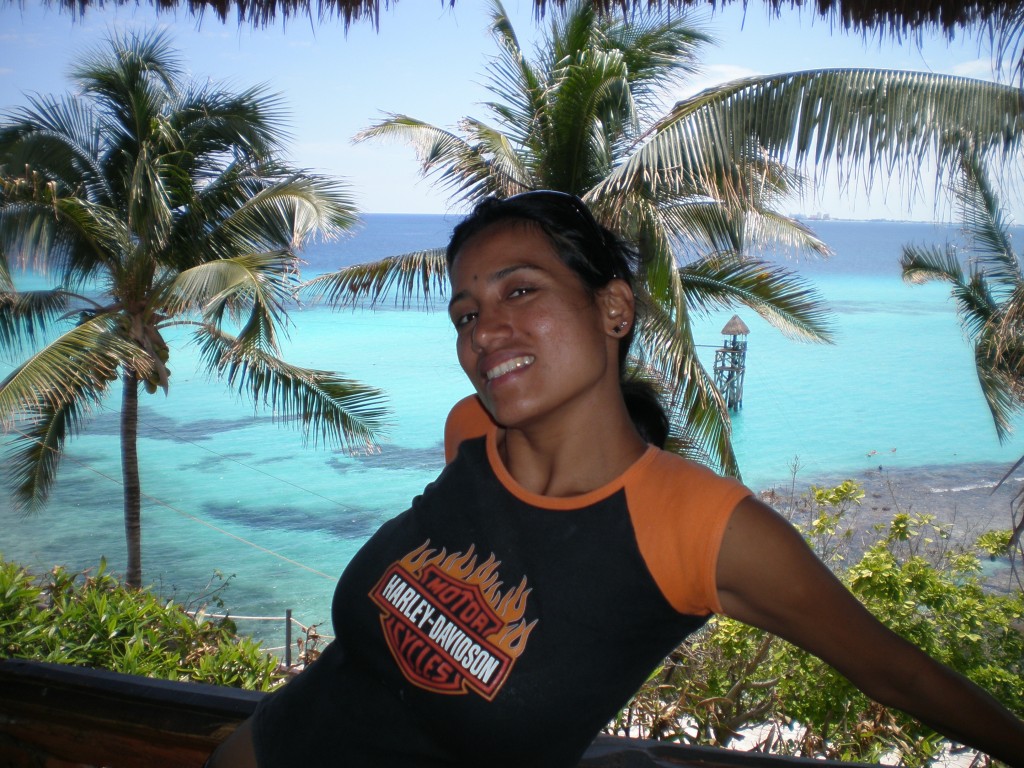
If you’ve ever spent any length of time in Cancun, Mexico, you’ve probably heard of “la isla”, as the locals call it. What they are referring to is the island known as Isla Mujeres, or the Island of Women. It’s a small enough little place, with only around 15,000 inhabitants and clocking in at a mere 7 kilometres (4.3 mi) long and 650 metres (2,130 ft) wide. It’s the perfect day trip given the beauty of the beaches and the relative smallness of the island, which makes it a popular destination with both locals and tourists looking to escape the cluster-fudge that are The Hotel Zone beaches.

Over the years, it’s become one of our favorite hangouts, and Cris and I usually spend at least one weekend per month out on the island. While it can be a bit crowded in the downtown area and Playa Norte (north beach) during the high season due to the amount of tourists, they usually head back to the mainland and Hotel Zone around 5 p.m. in the afternoon, which means if you want to have a quiet island dinner you just wait for the tourists to leave and then hang out with the locals and catch a later ferry back.

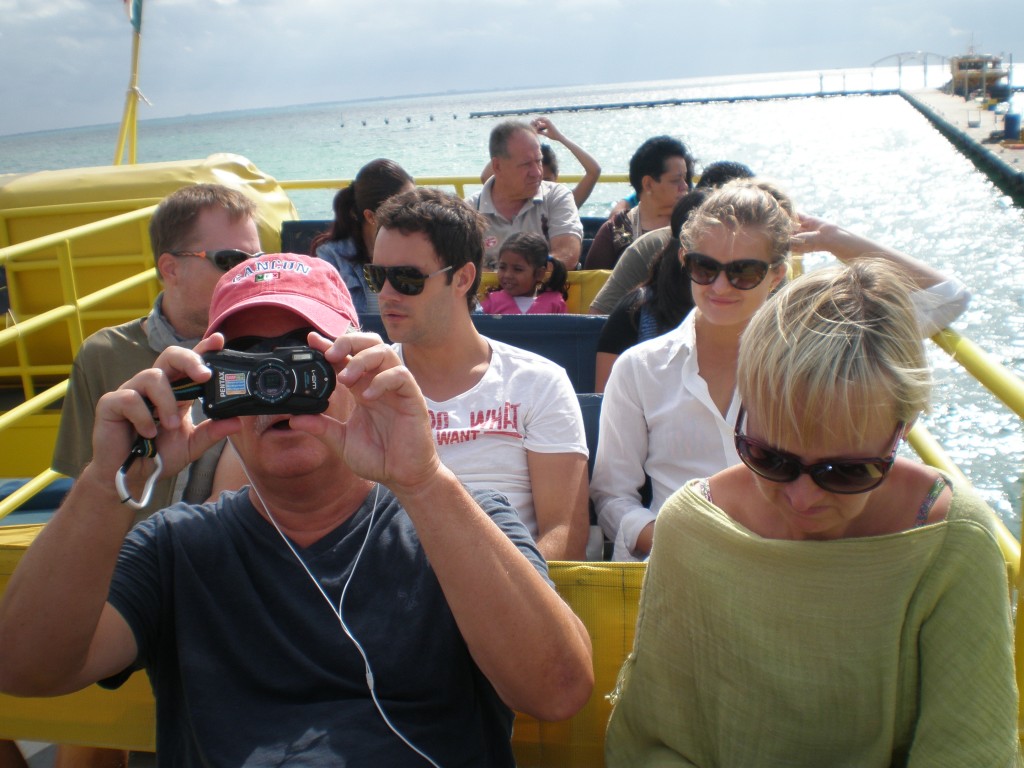
Speaking of which, can only get there via ferry, which takes 20 minutes or so from the mainland at Puerto Juarez (or Punta Sam if you are commercial transport or a local with a car), or from the ferry in the Hotel Zone. Only locals are allowed to drive vehicles on the island, which means the ferries are only bringing people over, although the Punta Sam car ferry will transport commercial vehicles with supplies for the island. As of 2013 prices are are 140 pesos round-trip (70 pesos there, and 70 back, or 10-12 dollars depending on the exchange rate), although if you are a resident (of the island) you can get a discount on those prices.

Destination Freedom, Isla Mujeres Ferry

On April 7th, we decided to take our Destination Freedom group out to the island for a day of relaxation and fun away from the headquarters to enjoy the beauty of The Riviera Maya. They’ve been here hard at work since the start of March, and we try and get them out of the house a few times per month to enjoy the area. It’s not all hard work! There’s plenty of fun and games as well, although we do run them pretty ragged in terms of 7-8 hours a day of classes and training to get their Spanish and social media skills going and their brands built up, so these little outings are a well-deserved reward.

After an early breakfast, we hit the ferry where we met up with my buddy Hans from the Pro Web Group and his girlfriend, who is a Russian expat here working for a travel agency alongside other Russians. He runs PSD2HTMLPros, among other sites, and specializes in website development. He’s helped with a few classes during our program and covers some of the basics of development for WordPress sites to help our members tweak their websites on their own for the little things that go into the day-to-day basics of running a WordPress blog.

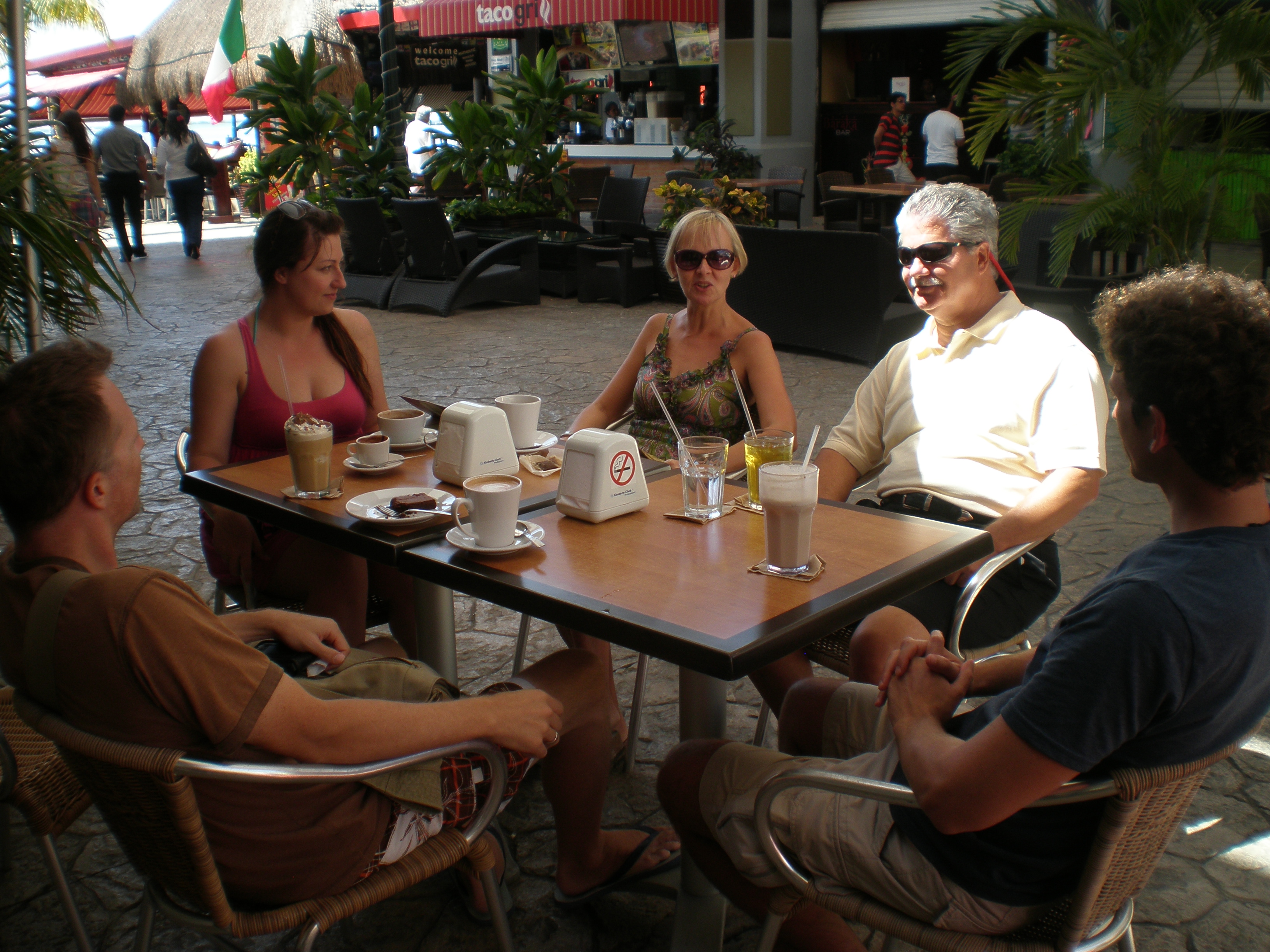
From there, it was a quick and uneventful ride out to the island where we disembarked and made our way to a local restaurant for the second breakfast, to satisfy the hobbit in all of us. Cris and I shared some French toast and coffee, while Dave and Sophie just had some fruit and tea, and Hans + his girlfriend Anna enjoyed their first breakfast of the day. After that, it was time to get started on finding a golf cart rental agency.

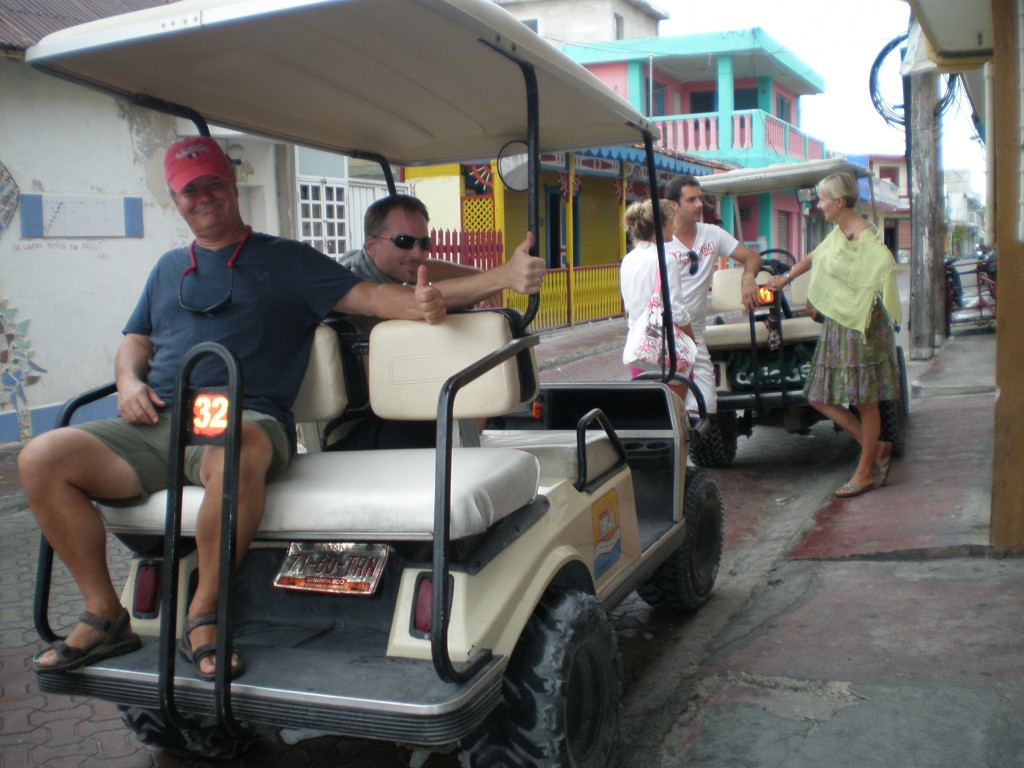
Normally, when it’s high season, you can negotiate a better rate on rentals (as low as 400 pesos for the day down from 500 for the day, which is the normal price), but they were being sticklers on the rates because we are in the middle of low season. Prior to breakfast Anna was able to get them down to 480 per cart, but after breakfast she was able to get them down to 475 for two. Not a huge savings; basically we got $20 USD off for the rental of two golf carts for the day. Note: you have to speak Spanish to get a discount, and it does depend on the time of the year + other factors. I tried negotiating with the first two rental agencies we came across and they wouldn’t budge. Anna has connections in the hotel industry since she’s a travel agent, and she did some well-timed name-dropping to get them to drop the rates a little. 

Destination Freedom, Isla Mujeres

The day started off a bit funky with partly cloudy skies and some spitting rain/drizzle, but there was only a 10% chance of rain overall for the day, so Cris and I weren’t worried about it. Sophie, on the other hand, doesn’t like to get wet, and we got a kick out of her cruising along in the passenger seat of the golf cart Hans was driving while holding her umbrella up over her face so she didn’t get any drizzle splatter. Go ahead…feel free and giggle. I know we did!

Destination Freedom, Isla Mujeres

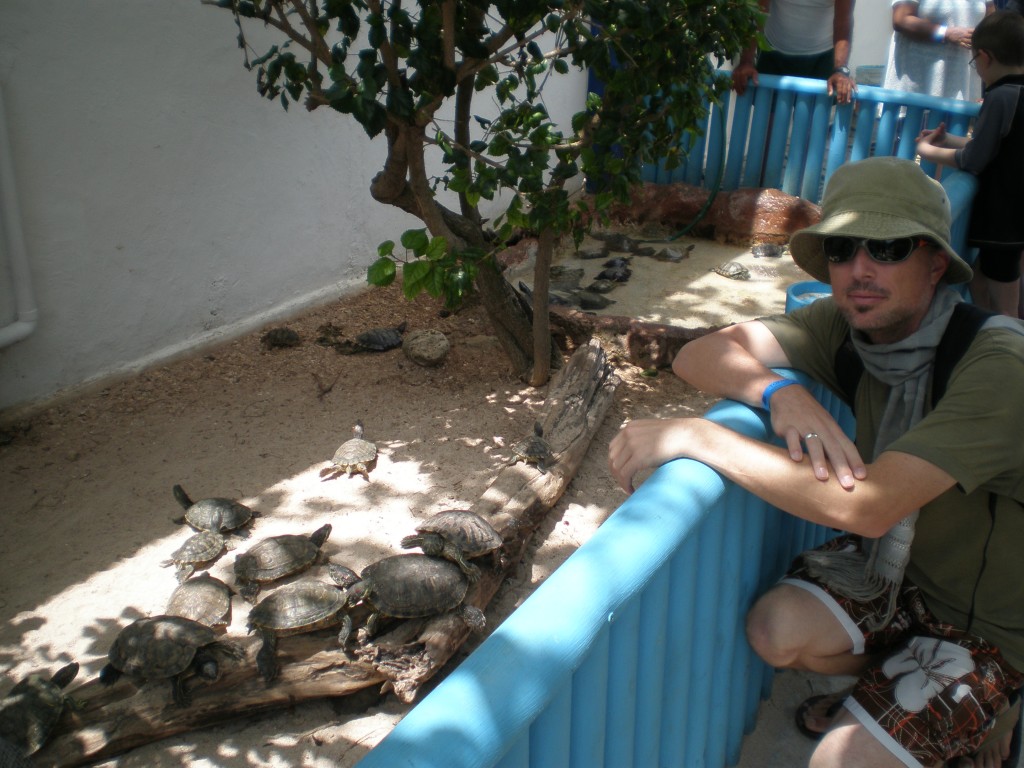
However, by the time we did some cruising around and checked out some of the island property tucked away in the back ends of the south-western section of the island, the clouds had broken and the sun was shining through. When we arrived at the turtle rescue farm it was a bright, sunny day.

Funniest thing? Check out the little guy who is hanging out towards the middle of the shot, soaking up the sun with his back feet splayed out and up in the air. Cris and I couldn’t figure out if he was planking, doing Pilates, or enjoying some morning Yoga. Regardless, he was enjoying himself completely!

Turtle Farm, Isla Mujeres

After we finished up at the turtle farm, it was time to cruise around to the south side of the island. While the beaches on the north side are great for soaking in the sun, the island’s best snorkeling, as well as the best views, can only be found on the south end. This is also where the vast majority of the locals live, considering the northern section is the “touristy” part of town where you can find Centro, Playa Norte and all the restaurants + hotels + rental agencies. Granted, there’s a lot of rental properties to find along the outskirts of the island, but the more private the retreat, the more you can expect to pay.

As a general rule, if you want to live on Isla Mujeres and you are looking for a middle-class lifestyle, you can expect to pay roughly what you would in Centro of Cancun. Between $200 to $400 a month for a single individual if you live under the radar, and $600 to $800 if you need extras like constant air conditioning (not really needed with the ocean breeze on a daily basis) and you drink a lot of beer/wine/alcohol.

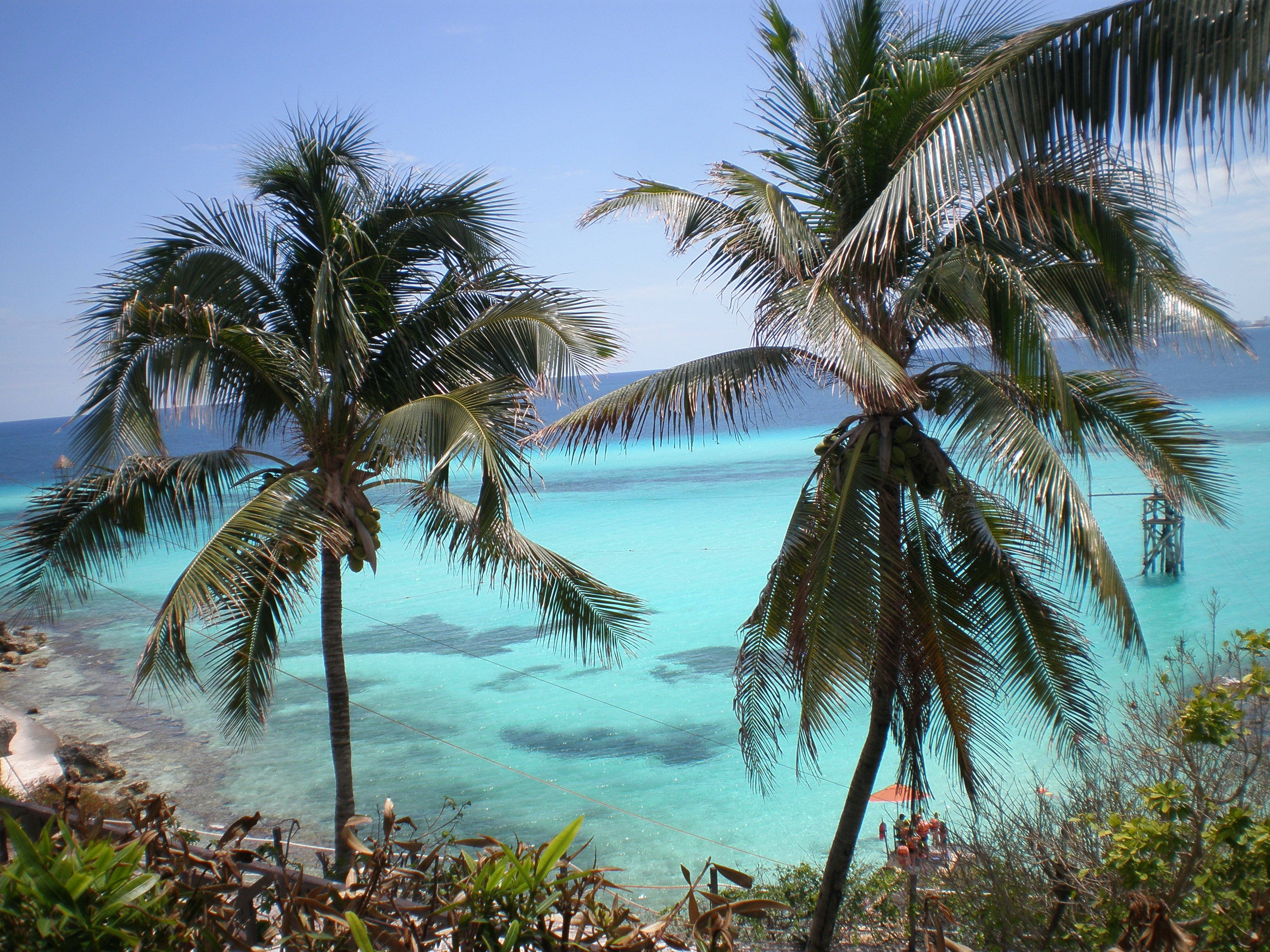
Once you get around to the south side of the island you get into those turquoise blue waters that Cancun is so famous for. There’s a park here called Parque Garrafon, which is a national park set up by the government. You can buy a day pass which gives you access to the snorkeling and kayaking areas, plus the beach and all the lounge chairs, the restaurant, locker rooms, zipline and more. While it’s easy to spend an entire day just at the park enjoying all the amenities, we were here to explore the entire island with our group, so we only stopped by for some photos.

Cristina, Marginal Boundaries

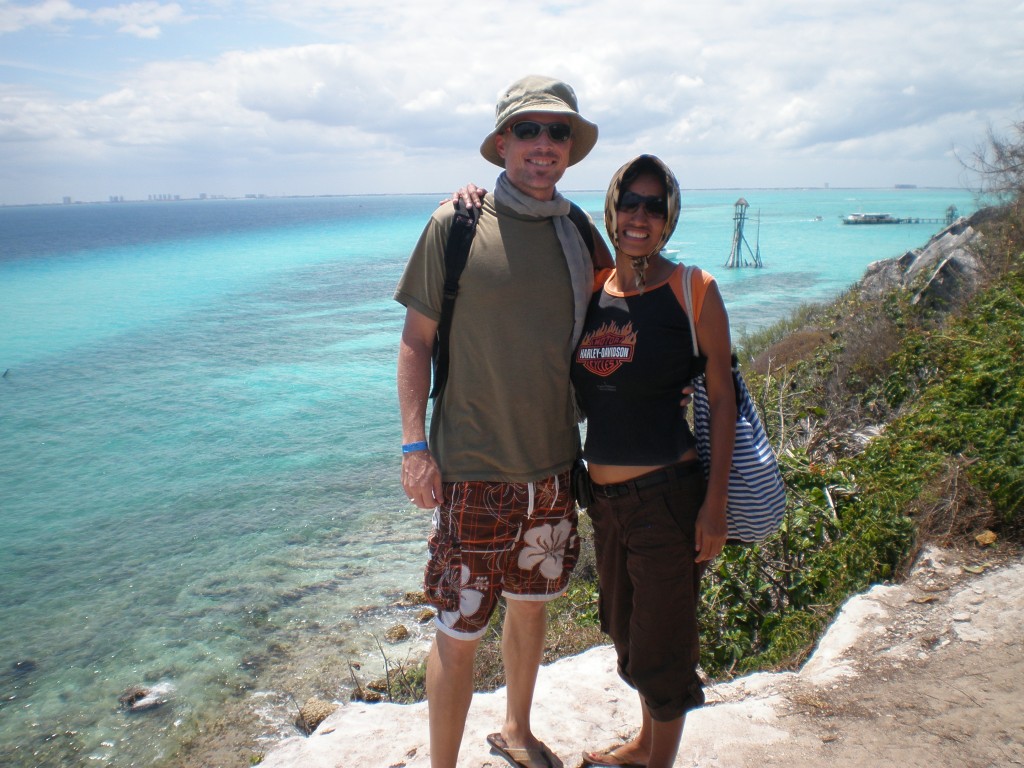
After that, we jetted down to Punta Sur, or the South Point, which is where the lone Maya ruin is located, as well as the lighthouse and the sprawling vista out over the Mexican Caribbean. There’s a restaurant, some tourist shops, a walking trail you can explore, as well as plenty of coastline to enjoy and take photos from. Including a ledge I almost stepped off when they were taking the below shot. Not a long drop, but it would have hurt a little bit =P

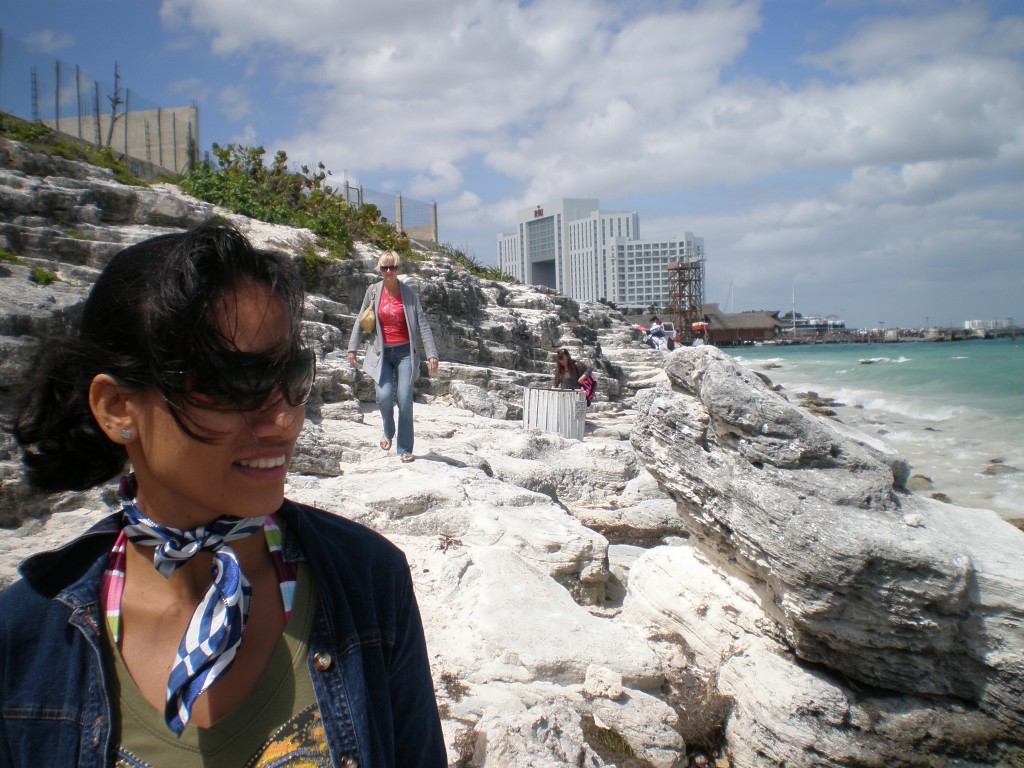
Tim and Cristina

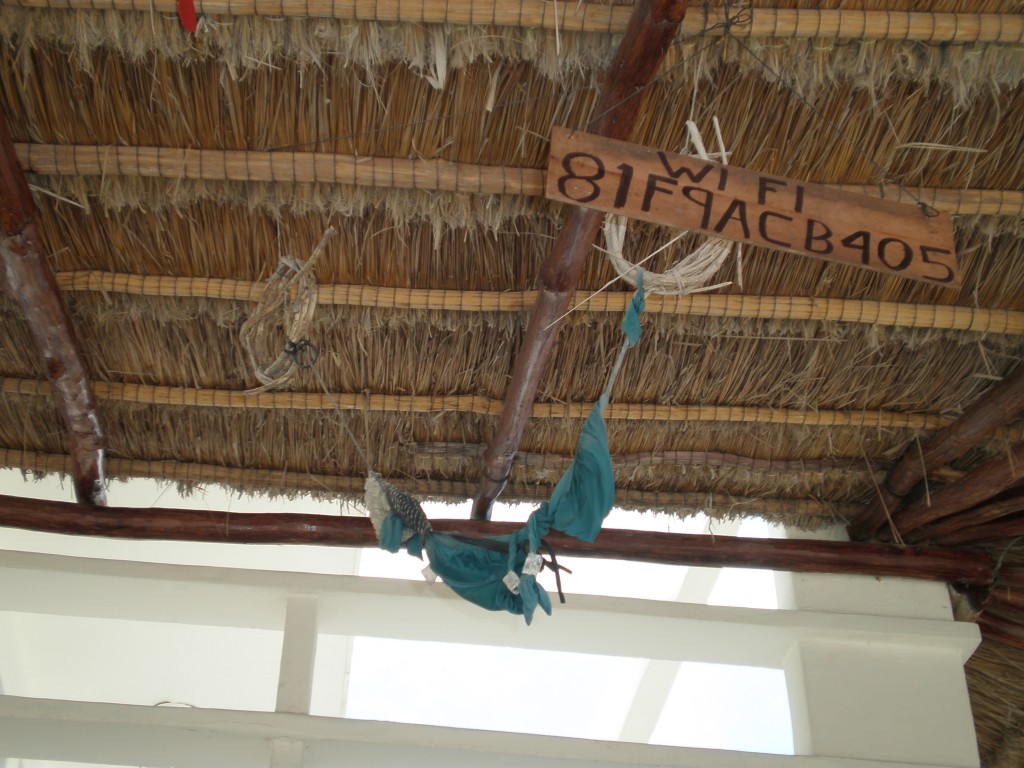
After that, we cruised back to Playa Norte and hit up one of the bars on the beach for a late lunch, beers and some kick-back-and-relax time before we had to take the golf carts back to the rental agency at 4:30. Decent food, cold beers, bit touristy in their prices but that’s what you get when you want to kick it beach-side  They had people’s forgotten swimwear and undies up on the ceiling, throwbacks to drunken days and nights out on the beach. Thankfully we didn’t see any skid-marks. And yes, that’s the WiFi code for the restaurant.

Bra Bar, Playa Norte, Isla Mujeres

We were pretty wiped out after that point, having been on the island from 10 a.m., so after we turned in our golf carts we headed back to the ferry for the 6 p.m. departure and made our way back to the headquarters for a good night’s sleep before returning to classes the next Monday morning.

To follow along with our adventures with the Destination Freedom Spring of 2013 event, don’t forget to check out the photo galleries at our Google+ and Facebook pages, plus you can check the videos of our recent adventure trip with Snail Adventures over at our YouTube channel. Plus, don’t forget that registration is open for the Summer retreat (July, August and September of 2013) where we’ll be doing the whole thing all over again with a new round of globally-conscious and unplugged adventurers who are ready to take their lives to the next level.  

Don’t forget to sign up for our free newsletter for several-times-a-week, your-eyes-only travel and entrepreneur tips, plus receive a complimentary copy of our 85-page starter book on location independence and living abroad, 30 Ways in 30 Days.
With over 1,500 copies sold, our flagship 568-page eBook is what started it all. Learn how to travel the world like I do: without a budget, with no plans, funded completely by your website and online ventures.

The Expat GuidebookGet Your Copy Today!

Unplug from The System, cure yourself of The Greedy Bastard Syndrome, tap into your universal potential and create your own reality. Build a brand, travel the world and realize your cosmic consciousness.

Beyond Borders - The Social RevolutionGet Your Copy Today!

Isla Mujeres, Mexico

Living off the grid in Cancun, Mexico

Posted by | Live Like a Local, Mexico, Quality of Life, Traveling Tips | 8 Comments

One of my favorite aspects of living in Cancun, Mexico is when I have the opportunity to dispel some of the myths around the city. The first of which is that people assume all of Cancun is The Hotel Zone, the all-inclusive strip of beach-front property separated from the mainland by a lagoon and only accessible by two bridges. It’s a haven of resorts, dance clubs, bars and restaurants, all of which are over-priced and full of obese, drunk, consumption-addicted tourists from all around the world. What many people don’t realize is that there is an entire city on the mainland that is completely separate from the HZ, and it marches to the beat of a very different drum.

Cancun proper is a thriving, bustling, very Mexican hub of activity, where a smattering of the locals speak English but the vast majority are simply living life as all Mexicans live: in Spanish, simply and without the bustle and hum of the tourist section that the governments of the U.S. and Mexico both promote.

One of the primary reasons I came here was the simple fact that Cancun is smack-dab in the heart of the Riviera Maya, while at the same time boasting an international airport and a global hub of expats. The combination of easy in-and-out transportation, along with the fact this is the hub for one of the region’s busiest ADO bus terminals for routes in and around the rest of Mexico, make this the perfect hub for travelers who are here to spend time immersing themselves in the Mexican culture.

On top of that…Cancun is cheap. Or at least it’s cheap if you want to live like a local, speak Spanish and get off the beaten path. If you want to live the typical tourist lifestyle here, it’s very easy to spend 2-3k per month in living expenses, but if you are looking for middle of the road accommodations, comfortable living, cheap healthcare, high speed Internet and a modern infrastructure, you can have everything you need as a working professional for around $600 a month (individual; couples are around $800 a month; families dependent on how many).

We have two rooms available for rent in Cancun for those of you in the market for something quick and easy.

  1. View Room One Here

  2. View Room Two Here

Mirador, Cancun

I’ve covered the costs and etc. in other posts, such as Cancun – Beyond the Hotel Zone, as well as in our immersion travel guide for the city, but there’s more to it than just the cost of living. I’m a resident, here on a visa, which means I get the same bonuses as Mexicans. I have access to the universal healthcare system (costs me about $300 per year, and that gets me unlimited, free prescription medication along with free healthcare, although there are some limitations, such as no orthopedic surgeries for 2 years to make sure I’m not just going to buy in and abuse the system), and I can get into the national parks and museums for free on Sundays alongside the nationals…which means I can visit places like Chichen Itza just like the locals do.

But what if you aren’t here as a resident, but just as a temporary visitor? Even then, the costs are cheap. Especially as it relates to medical tourism. The perfect example is Dave from Nomadic Retiree. He was one of our retreat members down here for the Spring 2013 Destination Freedom brand boot camp for March, April and May. He’s getting a lot of dental work done currently. Root canal, some crowns, cavity work and beyond. We were tallying up the costs the other day and he took his quote from the United States (between $14,000 and $15,000 depending on which dentists he talked to) and compared it what he’s spending here in Mexico…basically he’s saving around $12,000 USD by the time everything is said and done…and the work he’s getting done is more professional than anything he’s ever received in the United States.

He’s going to be writing a blog series on it, so you can follow along at his website for the nitty gritty details, but the bottom line is that even if you aren’t here as a resident, things are cheap. If he was on the universal healthcare system it would be even cheaper, as some of the procedures would be covered by the healthcare, but he’s only down here as a visitor, not a resident, and you only have access to the system once you have an official visa and go pay your healthcare taxes/fees.

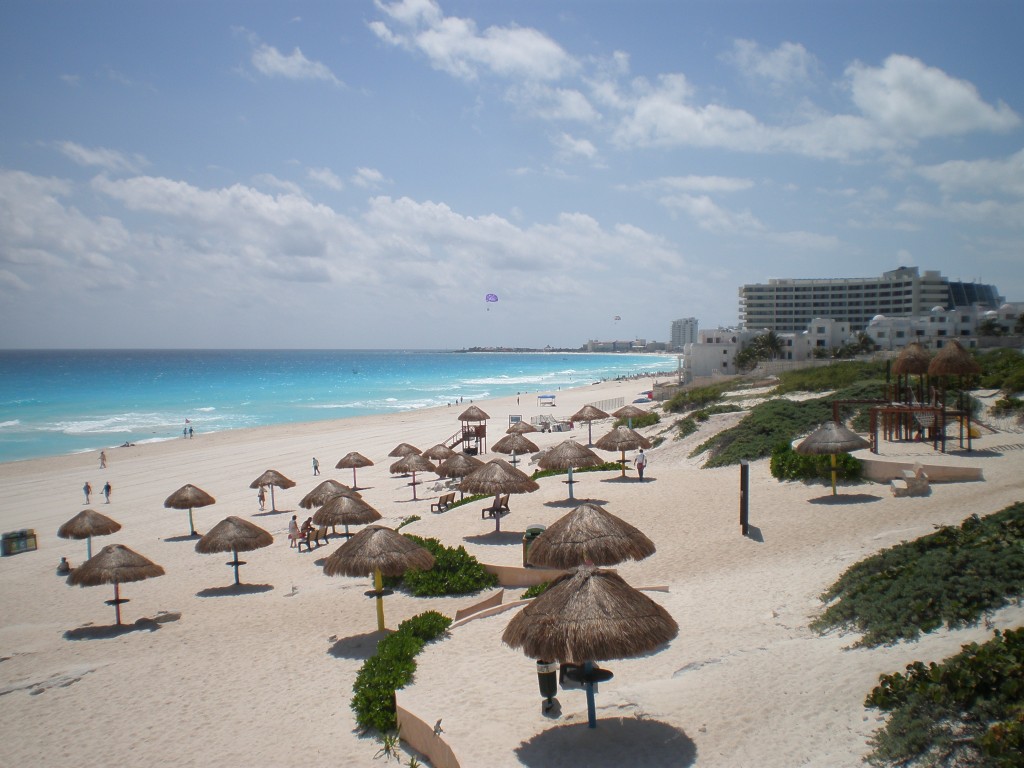
Playa Tortugas

Speaking the language also opens a lot of doors in Cancun. First of all, the taxi drivers won’t try and give you the gringo rates if you speak the lingo. Secondly, the bus drivers won’t try and short change you. Thirdly, the respect level gets cranked up to 11 when you are meeting the Mexicans on their own turf and speaking their language as opposed to being the arrogant tourist who demands their menu in English and berates the staff in the serving industry for not speaking English. I’ve already covered some of this in The Importance of Language Immersion for Expats, but the basic rule of thumb is this: when you give respect, you get respect back. It’s the age-old rule of reaping what you sow. Act like an arrogant twit, and you’ll be treated accordingly.

Knowing Spanish also gives you access to local rates on accommodations, as well as the ability to negotiate, which is one of the major bonuses of living in a Latin country: everything is negotiable. For example, my buddy DJ Vishnu negotiated a year’s worth of “free” rent at a hotel where he was staying simply by offering to manage their social media campaign for 2 hours a day and build them a new website. Which freed him up to work solely on his meditation videos and create more awesome music for his fans rather than stress about bringing in income from another source. Had he only spoken English, that door would have been completely closed to him.

There’s also an untapped market in terms of web development, social media development and beyond here on the local level, which means there are almost literally an unlimited number of job opportunities for the entrepreneurial sort who wants to come down here and put their nose to the grindstone. It’s the reason we are teaching Spanish language in our brand boot camps, so that our graduates can go on and find work not merely in English, but also in Spanish, both internationally and locally.

Destination Freedom by Marginal Boundaries

Cancun has a fairly negative reputation due to the Hotel Zone and its endless array of all-inclusive resorts and Spring Breakers, but the reality is that the city itself is completely separate. On the mainland we have quiet suburbs filled with parks and schools, Mexican barrios with 3 and 4 bedroom townhouses, a thriving middle class, the typical street food, plenty of mom-and-pop restaurants and businesses, cheap living and a completely laid-back, Bohemian way of life.

The buses run regularly, taxis are always available, there’s grocery stores every few blocks, you can find an Oxxo or Extra on every street corner, violent crimes are almost nonexistent, and it’s nothing but middle class Mexican families raising their children and living their lives no different than any other suburbia on Planet Earth. And if you get away from the Hotel Zone into the outer barrios on the mainland you’ll never see a gringo or an overweight tourist or find a strip club or hotel or any American restaurants. In fact, you’ll probably be one of the only foreigners that the locals have seen outside of when they go to the Hotel Zone or into the heart of downtown Centro.

And contrary to popular belief they don’t want to rob you, rape you, kidnap you or cut your head off. Cancun has a 2 in 100,000 murder rate compared to Washington D.C.’s 32 in 100,000 (as of 2010), so as far as safety goes, you are safer here than you are in the capitol of the U.S. Instead, the Mexican people are warm, inviting, friendly and ready to kick back a beer or smoke a joint with just about anyone. This is called the “land of tomorrow” for a reason: if you give a Mexican a reason to take a break, relax and enjoy life, they take it. End of story. And once you get a little Spanish under your belt you’ll quickly find that everyone, everywhere, is always looking to strike up a conversation and kick back a cold one, no matter the color of your skin or what country you come from.

On top of all that, you have access to the entire Riviera Maya, from places such as Isla Mujeres to the secluded coves at Akumal, from Isla Blanca to Cenote Ik Kil, from Playa del Carmen to Tulum to Cozumel and beyond. This really is a magical place to be living, and I couldn’t wish for a better place to call home! Don’t forget to give us a shout if you are going to be in the area as we are always up for beers and fun, and if you have questions about anything related to long-term living in the city, whether it’s apartment rentals or beyond, let us know!

Tim and Cristina

If you want to rough it on your own, head on over to our Cancun travel page for boots-on-the-ground information, or pick up our best-selling Cancun travel guide (on sale since 2011!)

cancun travel guide

Don’t forget to check our Cancun page for dozens of videos from our time here, as well as other Cancun-specific posts below.
Cost of Living in Cancun, Mexico
Modern Mexico: The Real Story
Cancun, Mexico – Beyond The Hotel Zone
Living Off The Grid in Cancun, Mexico
Market 23 in Cancun
Market 28 in Cancun
Gourmet Italian in Cancun – Assaggiare
Tacos in Cancun – Tacos Rigo
Tacos in Cancun – Los Aguachiles
Beaches in Cancun – Playa Tortuga
Beaches in Cancun – Puerto Morelos
Tips

Tipping Etiquette Around The World

Posted by | Live Like a Local, Quality of Life, Traveling Tips | 11 Comments

Growing up in the United States, I was brought up with the custom of tipping a minimum of 15% any time we went out to eat at a restaurant other than a fast food joint. And while I always resonated with the opening scene from Reservoir Dogs, it wasn’t until I began traveling that the world opened up to me and I discovered that mandatory tipping was largely only practiced in The West. And it definitely wasn’t until I traveled to Eastern Europe and The Mediterranean extensively – eventually living in Bulgaria for over two and a half years – that I learned the vast majority of the developed world does not tip “just because”, and promptly became a staunch “tip when it’s for excellent service, not simply because they are doing the job their employer paid them to do” Mr. Pink type of individual. Read More